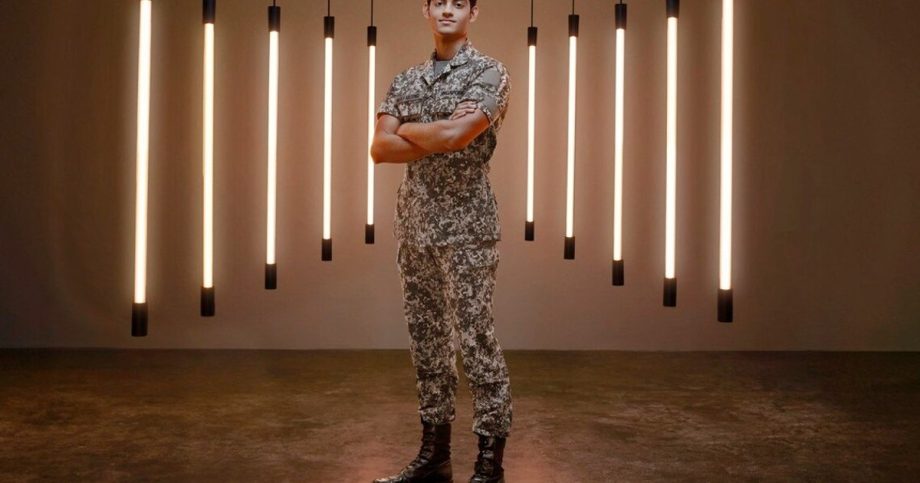
When Military Expert 4 Apprentice Florian Ableitner first thought of joining the armed forces, he was convinced he was going to be a pilot.
Much of that certainty came from his time at the Singapore Youth Flying Club, where several of his instructors were former Republic of Singapore Air Force (RSAF) fighter pilots.
In and out of the cockpit, they would share stories from their flying days – of operating at speed, keeping track of what was happening around them and staying alert to potential threats.
For Ableitner, it offered an early glimpse of what a career in the Air Force could look like. And for a while, he expected to follow a similar path.
Then, at Officer Cadet School, another side of defence caught his attention. Recruiters from what was then the Command, Control, Communications, Computers and Intelligence (C4I) community spoke about work where the challenge was not flying an aircraft, but making sense of a security picture that could change in real time.

Being awarded the SAF Merit Scholarship in 2022, Ableitner (back row, third from left) marked the start of a path that would take him from aerospace engineering at Nanyang Technological University (NTU) into military intelligence.
“The situation never really stays still,” he says. “The picture changes daily, sometimes hourly, and the job is to keep analysing that shifting data and turning it into intelligence that decision-makers can act on.”
He was also intrigued by how emerging technologies such as drones and artificial intelligence were changing both the nature of warfare and the way information was gathered and analysed.
The combination of technology, analysis and a constantly evolving security environment gave him a different way to imagine his future in the armed forces.
Instead of following his instructors into the RSAF, Ableitner joined the C4I community, which would later become the Digital and Intelligence Service (DIS), and took up the Singapore Armed Forces (SAF) Merit Scholarship in 2022 to study aerospace engineering at Nanyang Technological University.
Learning how AI and drones change modern warfare
Before starting his degree, Ableitner was posted to the SAF Computer Vision Unit, where he worked with a team improving visual-recognition algorithms used to detect, identify and locate potential objects of interest more quickly and accurately.
It was his first opportunity to see how technology could help turn raw information into something useful for intelligence work.
At university, he began exploring the same idea from another angle: not just how machines could interpret what they saw, but how they could be made to act on their own.


Read Full Article At Source