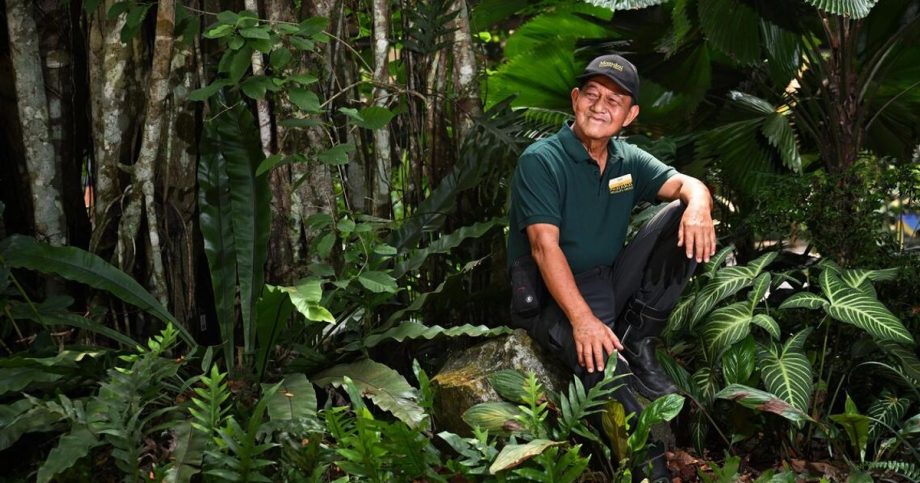
SINGAPORE – Said Mohamed’s life is deeply rooted in the Mandai Wildlife Reserve.
Not surprising, as he started working at the then Singapore Zoo at the age of 27 and spent the next 44 years proudly watching his “leafy children” stretch towards the sun, weather the elements and blossom into their full potential under his protective care.
One such “child” is the 50m-tall buah sentul, or cotton fruit tree, that sits at the entrance to the proboscis monkey exhibit at the wildlife reserve. He planted it as a seedling and nurtured it for the next 40 years.
“I also met and married my supervisor at the zoo,” said the 71-year-old, laughing.
Having spent almost a lifetime making sure the plants that now flourish in the five attractions at the wildlife reserve thrive, Said is not ready to give it all up and retire any time soon.
“Apart from having made good friends and a social network here to help keep me mentally alert, I also need to work to be able to support my son financially,” he said.
Said’s son, 37, has a disability and still attends a special school for adults. Said has also hired a domestic helper to manage his son’s daily needs.
While more than three in five seniors in Singapore continue punching the clock beyond their retirement age, citing social connection or mental stimulation as top reasons, a substantial proportion, like Said, work for financial reasons.
Even among Singapore’s high-income respondents, 48% said they needed additional income to cover daily living expenses and ensure long-term financial security.
These were the findings from a November 2025 survey conducted by Sun Life, an international financial services organisation, which looked at what it meant to age with confidence and the steps seniors were taking to make their vision of retirement a reality.
Called Retirement Reimagined: Asia’s Retirement Divide, the interviews were conducted online with a total of 3,006 people across Hong Kong, Indonesia, Malaysia, the Philippines, Singapore and Vietnam – with those from the island republic totalling 521.
A similar result turned up in a survey conducted around the same time, between September and October 2025, by the National Trades Union Congress (NTUC) with nearly 600 respondents across all age groups.
The NTUC study found that almost half, or 46%, of the respondents expressed a desire to work past the age of 70.
This willingness increased with age.
More than 66% of those aged 64 or above want to continue working past 70, compared with only 51% of those aged between 50 and 63.

The 50m-tall buah sentul, or cotton fruit tree, that Said Mohamed planted and nurtured from a seedling now towers over the entrance to the proboscis monkey exhibit at the wildlife reserve.
ST PHOTO: AZMI ATHNI
Since July 2026, Singapore’s statutory retirement age has moved from age 63 to 64, and the re-employment age has also gone up to 69 from 68.
For someone approaching retirement, this means another year of earnings, more time to save, or an opportunity to move into a less demanding role.
And according to the Ministry of Manpower’s Labour Force in Singapore Advance Release 2025, between 2015 and 2025, the employment rate among workers aged 65 and above rose from 24.7% to 31.5%.
The NTUC survey found that maintaining mental and physical health by staying active was a top motivation, followed closely by the need for income to cover living expenses. These motivations are reflected in broader labour market data.
Based on the findings of the survey by his company, Sun Life Singapore chief executive Christopher Albrecht said: “What we are seeing is not a single retirement experience, but two very different realities. For those who are prepared, working longer can be a choice that offers flexibility and freedom. For others, it reflects financial pressure.
“Planning early, and planning holistically, is what determines which path people are on.”


Read Full Article At Source