AI humanoid robots to be deployed with Home Team officers by 2028: Edwin Tong

AI humanoid robots to be deployed with Home Team officers by 2028: Edwin Tong


SINGAPORE – Hazmat, prison and forensics officers are set to have new teammates in the form of humanoid robots powered by artificial intelligence.

These robots are to work alongside Home Team officers in real operational settings by 2028, said Second Minister for Home Affairs Edwin Tong.

Speaking at the launch of the Home Team Humanoid Robotics Centre (H2RC) in one-north on Sept 30, he said the aim is to support, not replace officers.

He said: “The robot takes on the routine, physically demanding or the dangerous work. And our officers focus on the work that calls for empathy, for judgment and for leadership, the human instincts behind the job that the Home Team officers do.”

Some $100 million has been committed to the centre, which is run by the Home Team Science and Technology Agency (HTX) to develop robots to enforce public safety.

Potential uses include ambulance resupply and hazmat operations for the Singapore Civil Defence Force, post-blast investigations for the police, and prison cell searches for the Singapore Prison Service.

Tong said in cases of chemical leaks and the aftermath of explosions, officers have to handle dangerous materials and risk a secondary explosion or collapse.

A humanoid robot is demonstrated in a mock post-blast investigation during the official opening of the Home Team Humanoid Robotics Centre.

A humanoid robot conducting a mock post-blast investigation during the official opening of the Home Team Humanoid Robotics Centre.

ST PHOTO: GAVIN FOO

But with humanoid robots, the machines can perform the dangerous tasks while officers are kept safe and freed up to do more.

Tong said: “In future, a humanoid could take the place of this officer. It can go in and do that, and no officer needs to stand in the way of unnecessary danger.”

He also gave the example of how the robots can perform yard checks, freeing prison officers to engage inmates and focus on their rehabilitation.

Embracing new technologies for public safety is a necessity for Singapore as it has an ageing and limited workforce, said Tong.

He added that while the Home Team has already been using science and technology to improve its operations, it is now time to bring AI out of the digital world and into the physical one via these robots.

To do it safely, the robots will be powered and trained on HTX’s sovereign AI NGINE, which was recently boosted with the latest AI chips. HTX is the first in Singapore to operationalise Nvidia’s GB300 chips, allowing it to train larger multimodal models and embodied AI models.

Dedicated facility

The H2RC is the first centre of its kind dedicated specifically to humanoid robotics for public safety, said Tong. The facility spans 29,000 sq ft, or roughly the size of six basketball courts, and allows for collaborations between the Home Team, industry and academia.

It supports the end-to-end development of AI humanoid robots, with areas for motion-capture systems, human demonstration and simulation, data collection and physical testing.

This includes recreated environments and scenarios the AI robots are expected to be deployed in, including a post-blast scene with debris, a prison cell and parts of a chemical plant.

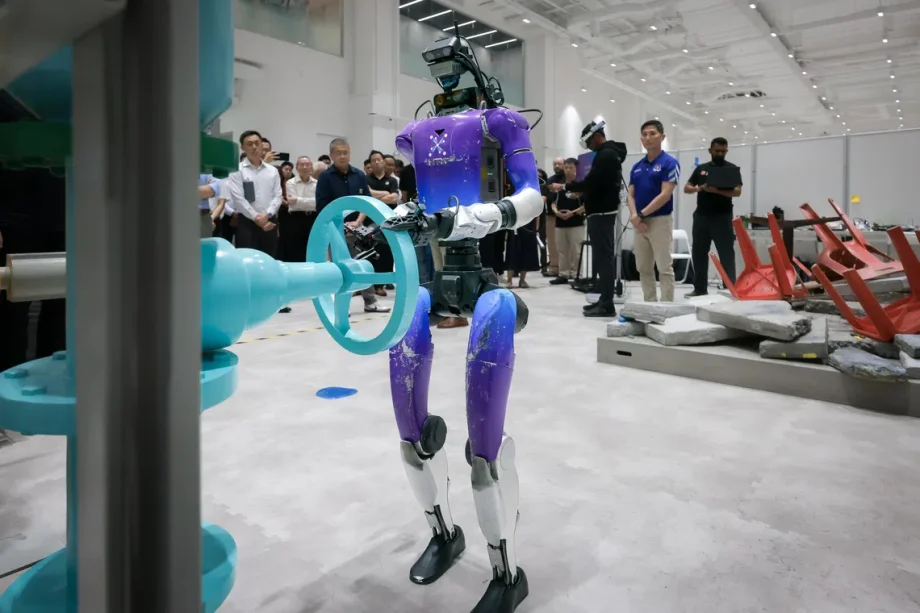
A humanoid robot demonstrates a mock hazmat containment at the Home Team Humanoid Robotics Centre.

A humanoid robot demonstrating a mock hazmat containment at the Home Team Humanoid Robotics Centre.

ST PHOTO: GAVIN FOO

The centre will also develop agentic AI capabilities, which involves using AI agents that can act on behalf of humans, taking on tasks that require not only repetition but also reasoning. This will allow the AI robots to complete multi-step missions, recover from failures, and adapt to changing environments and constraints.

During the launch, a Memorandum of Understanding was signed by HTX and ST Engineering to advance robotics and embodied AI capabilities. Other collaborators at the centre include US-based FieldAI, General Robotics and French company Mistral AI.

Chin Zhihao, deputy director of HTX’s Robotics, Automation and Unmanned Systems Centre of Expertise, said the centre aims to build an ecosystem that brings together expertise it can tap for public safety. He said H2RC intends to bring on more partners and will not be limited to specific platforms or providers.

He said: “We don’t want to be locked in to a specific platform or model. The AI landscape moves very fast, with new platforms becoming available every now and then, with different strengths.

“It is important for us to be agnostic in this sense so we have the freedom to leverage on the latest available technologies, with public safety use being key.”


Read Full Article At Source

Share. Save. Don't Miss The Buzz: XFacebookRedditLINETelegramWhatsAppGmail

Leave a Reply