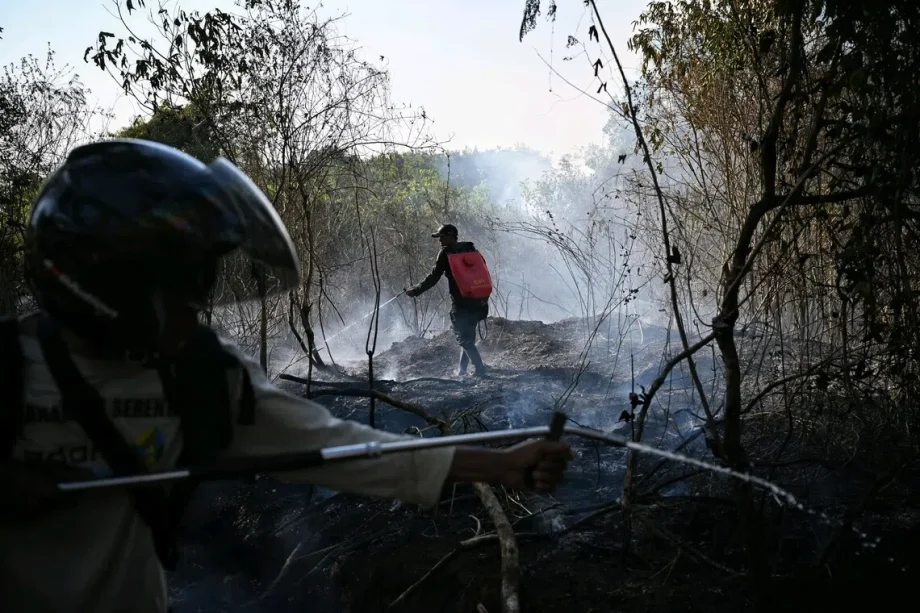
JAKARTA – A helicopter hovered over a reservoir in South Kalimantan, dipping a bucket suspended from a long cable into the water before heading back towards the fires.
On the ground, two men dragged a hose through dry woodland, spraying water at flames moving through the undergrowth. One wore a motorcycle helmet.
Scenes like these have returned across parts of Indonesia in 2026, sending smoke towards neighbouring Singapore and Malaysia and reviving memories of the country’s worst haze crisis.
But this is not 2015.
At the height of that crisis, then President Joko Widodo promised Indonesia would solve the haze problem within three years.
Some 2.6 million ha burned in 2015, followed by another 1.65 million ha in 2019. In 2026 alone, nearly 900,000 ha had burned by late August, according to independent forest monitoring platform Nusantara Atlas.
But the 2026 fire season is far from over. Forestry Minister Raja Juli Antoni said on Sept 16 that the wildfires could continue until early November, with the rainy season expected to arrive later than previously forecast.
The scale of burning over the past decade suggests that the measures introduced after 2015 – from tougher enforcement to peatland restoration and earlier detection – have helped reduce the extent of burning.
But the return of fires in 2026 also exposes where those reforms remain vulnerable.
In South Kalimantan, The Straits Times found that clearing land without fire can still cost considerably more than burning it.
Hotspots have returned to concessions. And Indonesia is facing a major fire season without the government body created after 2015 to restore and monitor its fire-prone peatlands. Its mandate ended in 2024.
The consequences are already being felt. Health Ministry data showed 113,336 wildfire-related respiratory infections across seven affected provinces as at Sept 9, more than double the 50,891 recorded on Sept 1. Some 12.5 million people had been exposed to haze.
This is the central tension a decade after 2015: Indonesia is better at fighting fires once they start, but the incentives to burn – and some of the weaknesses in preventing fires – remain.
Burning still pays
In South Kalimantan, Fitria Khairani, who heads Syamsudin Noor village, explained why burning remains attractive. Hiring an excavator costs around 1.25 million rupiah (S$90) to 1.5 million rupiah a day, including the operator. She estimated that it could clear roughly one hectare a day.
“If it is burned (instead), it is indeed fast, especially when the land is dry,” she said.
Some people believe burning makes the soil more fertile, Fitria said, although established farmers in the village generally use excavators or clear land manually.

Fitria Khairani, who heads Syamsudin Noor village, said some people believe burning makes the soil more fertile, although established farmers in the village generally use excavators or clear land manually.
ST PHOTO: ARIFFIN JAMAR
A World Bank study released in February 2021 found a similar cost gap. Small-scale operators in Sumatra, Kalimantan and Papua spent about 3.5 million rupiah per ha clearing land with fire, compared with 4.6 million rupiah manually, 6.6 million rupiah using semi-mechanical methods and 7.7 million rupiah mechanically.
Higher upfront costs could be offset by better returns when non-burning methods were combined with improved agricultural practices, the study found.
In some cases, the authorities suspect people are being paid to start fires.
National Disaster Management Agency (BNPB) chief Suharyanto said on Sept 7 that a suspected fire-setter caught in Jambi, on Sumatra island, had allegedly been paid 500,000 rupiah to set fire to forest land. In West Kalimantan, officials found recently burnt land already being prepared for oil palm cultivation while fires were still burning elsewhere, he said.
“There are indeed deliberate efforts in the field to burn,” he added.
Indonesian President Prabowo Subianto ordered the authorities to investigate who was behind the fires and how burnt land could be converted into plantation land so quickly.
Jakarta-based think-tank Center of Economic and Law Studies (CELIOS) estimated on Sept 2 that forest and land fires between January and August could cost Indonesia between 39.29 trillion rupiah and 123.1 trillion rupiah in economic and health losses.


Read Full Article At Source