by Jeremy Ray Jewell
語言:
English
Photo Credit: Screenshot
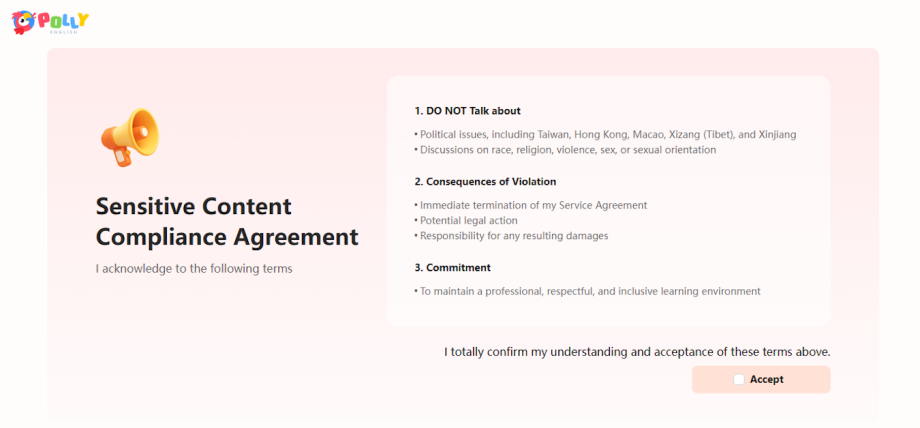
APPLY TO TEACH for Polly English and, before entering a classroom, the platform presents a screen titled “Sensitive Content Compliance Agreement.” Under “DO NOT Talk about,” it prohibits discussion of “Political issues, including Taiwan, Hong Kong, Macao, Xizang (Tibet), and Xinjiang.”
The next section is harder to dismiss as ordinary classroom etiquette. Under “Consequences of Violation,” the screen lists “Immediate termination of my Service Agreement,” “Potential legal action,” and “Responsibility for any resulting damages.” It does not say what kind of legal action, which damages might qualify, or how far those consequences reach. A teacher working outside the PRC is asked to accept an open-ended legal and financial warning for discussing some of Beijing’s most sensitive political questions.
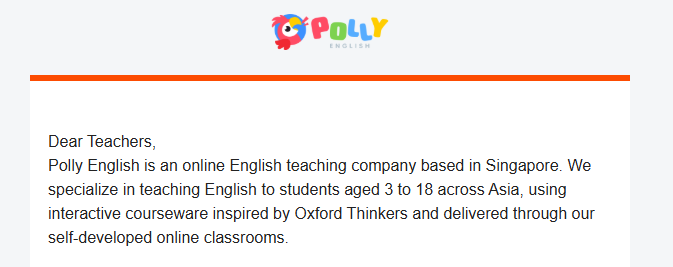
Nothing on that screen is presented as PRC law. Polly English describes itself as an online English teaching company based in Singapore, and its teacher terms name Little Moon Pte. Ltd. as the contracting party and place the agreement under Singapore law and Singapore courts. That makes the arrangement more revealing, not less: recognizable PRC political red lines appear inside a private contract governed somewhere else.
The ambiguity lands in a context in which Beijing has increasingly asserted that politically defined conduct can be punished even when the accused is outside territory under its effective control. In June 2024, five PRC authorities issued guidelines allowing trials in absentia for alleged separatist offenses related to Taiwan independence. In 2026, Article 63 of the Law on Promoting Ethnic Unity and Progress turned to organizations and individuals outside the PRC. They may be held legally liable for acts against the PRC that are deemed to undermine ethnic unity and progress or to create ethnic division. Amnesty International calls its core prohibitions broad and undefined; the European Parliament reads its extraterritorial reach as allowing prosecution abroad.
There is no publicly available evidence that Polly is enforcing those laws, or that any Chinese authority instructed the company to write this agreement. The mechanism is what matters. A platform can absorb political pressure originating in one market, convert it into a private contractual rule, and place the risk on workers in another jurisdiction. This is not only a story about Beijing’s reach, but about how platform work is built: nominal independence for the worker, centralized rule-making for the company. Political restrictions are the conspicuous cargo. The machinery that carries them already governs labor, and it does not stop at borders. That makes what Nick Srnicek and others have called “platform capitalism” more than a labor question. It is a question of political sovereignty.
Polly recruits English-speaking teachers, largely from North America and the Philippines, for one-to-one classes. Its recruitment portal runs on a Chinese country-code domain, and the apps are distributed through app stores in the PRC. The consumer site is in Simplified Chinese, selling lessons with American and Canadian schoolteachers to parents who sign a course subscription agreement on the same domain.
Plenty of employers tell staff to keep politics out of the classroom, and in a service for children that would be unremarkable. But Polly’s list names five specific places, and those five are the territorial, sovereignty and ethnic-political questions Beijing treats as core red lines. Four turned up in the 2018 Marriott episode, when a customer survey listing Tibet, Hong Kong, Macau and Taiwan as countries prompted Shanghai’s cyberspace regulator to order Marriott’s Chinese website and app shut for a week, the same year the civil aviation regulator instructed 44 foreign airlines to relabel Taiwan.
One of those names is written “Xizang (Tibet).” Since a State Council white paper in November 2023, PRC state media have systematically substituted “Xizang” for “Tibet” in English, a shift Tibetan groups read as displacing an internationally established name. Terminology alone proves nothing about who drafted the clause, but the ordering is worth noticing: the PRC’s preferred term leads, the internationally recognized one trails in brackets. A company that presents itself to recruits as Singapore-based has adopted Beijing’s sequence.
Read Full Article At Source