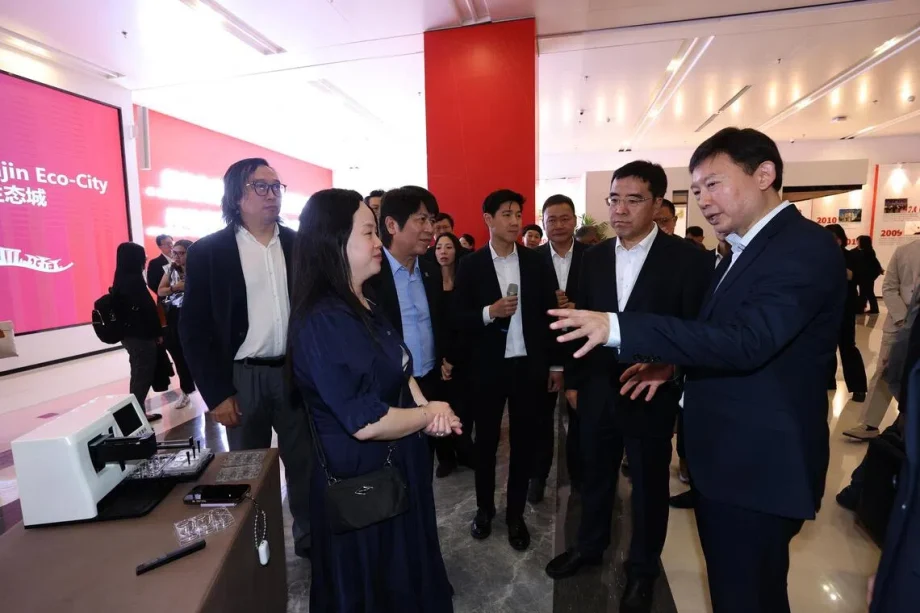
BEIJING – Singapore and China are looking to take their nearly two-decade partnership on the Tianjin Eco-City beyond its physical boundaries, using the project as a base to open up more opportunities for businesses across the wider Beijing-Tianjin-Hebei region, said National Development Minister Chee Hong Tat.
Speaking to reporters on Sept 18 as he wrapped up his visit to China, Chee said both sides have agreed to look at a longer-term development plan for the government-to-government project as it approaches its 20th anniversary in 2028, with newer technologies and approaches in urban planning potentially shaping its next phase.
“We hope that the collaborations we have in Tianjin Eco-City can provide a useful platform for Singapore and Chinese companies to take some of the innovations and business solutions into other parts of China,” he said.
He added that Chinese companies that wish to go to South-east Asia can likewise use Singapore as a launch pad into the region.
Chee was in Beijing, Xiong’an and Tianjin from Sept 13 to 18 to co-chair the Singapore-Tianjin Economic and Trade Council meeting, along with Tianjin Mayor Zhang Gong. He also met Tianjin Party Secretary Chen Min’er.
He is accompanied by Senior Minister of State for National Development and Transport Sun Xueling. More than 80 representatives from Singapore businesses are on the trip with him, some of whom already have operations in Tianjin while others joined to explore new business opportunities.
Established in 2008, Tianjin Eco-City, about a two-hour drive from Beijing, is the second bilateral project between Singapore and China after the Suzhou Industrial Park that was launched in 1994.
The 30 sq km city, about three times the size of Sengkang, one of the largest residential towns in Singapore, has grown considerably since, with a resident population of nearly 200,000 and more than 30,000 registered companies and institutions across sectors such as technology, research and development, and logistics.
Read Full Article At Source