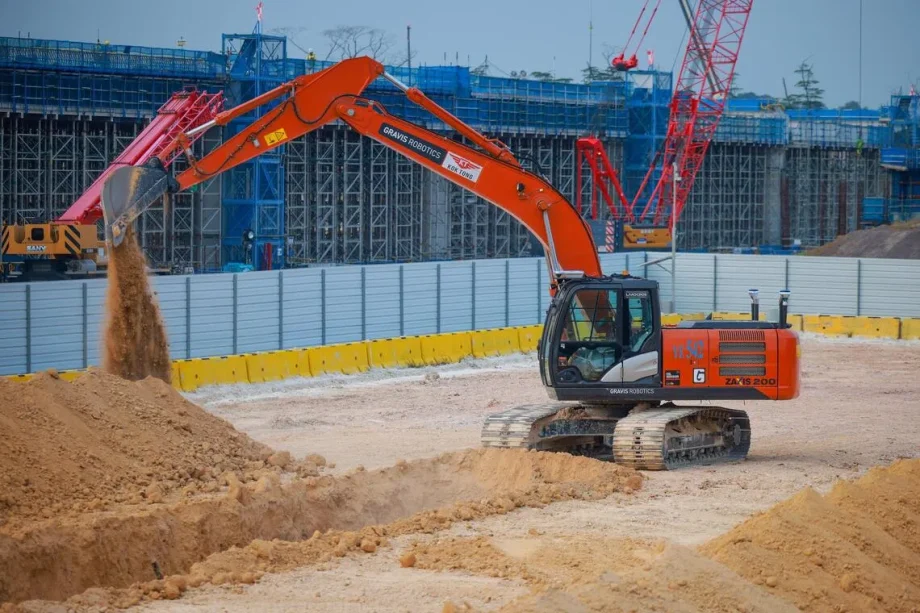
SINGAPORE – What if the next machine at Singapore’s new construction sites had nobody sitting behind its controls?
A pilot, launched by JTC Corporation and Kajima, is putting autonomous excavators and compactors to the test at Bulim autonomous yard in Jurong Innovation District, with the machines performing tasks under real site conditions. They can carry out assigned tasks independently, while operators monitor and oversee them remotely from a nearby control room.
The project will explore how autonomous heavy construction equipment can help address manpower constraints and improve workplace safety.
Calvin Chung, assistant chief executive of engineering and operations at JTC, said: “If the pilot succeeds, we will deploy autonomous heavy construction equipment across suitable projects in our pipeline and support wider industry adoption.”
The first phase of the project started in January and includes four machines: two excavators and two compactors. It is set to end in early 2027.
The second pilot will then begin, introducing autonomous bulldozers and dump trucks to create a coordinated fleet. Once the trials are complete, the machines may be pushed out to JTC’s sites, specifically within the Jurong Innovation District, by 2028.
This is the first project at JTC’s new 1ha sandbox, announced by National Development Minister Chee Hong Tat at ConTech@PDD in July. It is being conducted in partnership with the Public Sector Science & Technology Policy & Plans Office, and Housing Board.
Improving productivity with fewer workers
Productivity is crucial as JTC is looking at a pipeline of at least 800ha of earthworks projects over the next five years.
According to the Building and Construction Authority, Singapore’s total construction demand is projected to reach $53 billion in 2026, while industry reports show the sector faces a persistent manpower shortfall of nearly 15 per cent across various roles.

Besides excavators, compactors are also being tested at JTC’s sandbox for validating autonomous construction equipment under real site conditions.

Read Full Article At Source