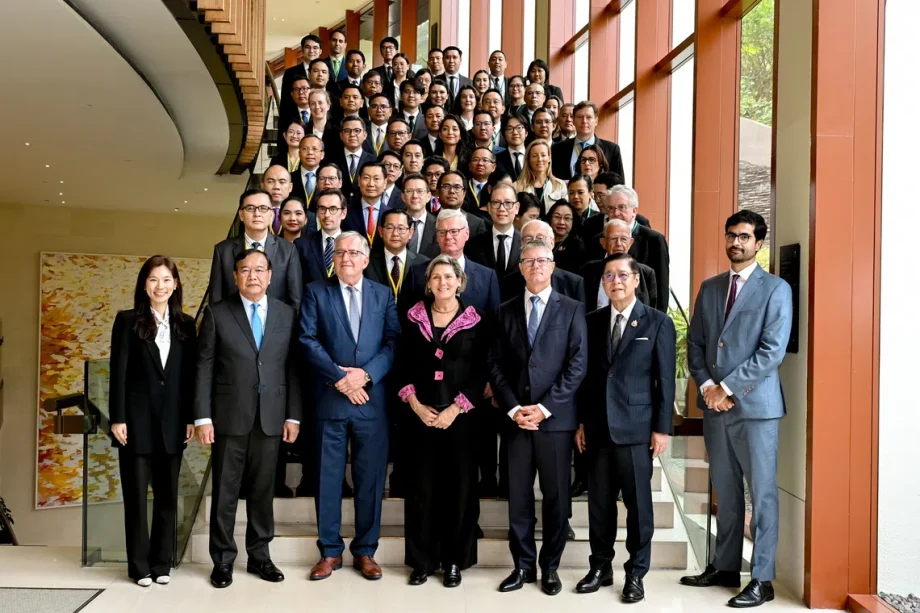
A conciliation meeting between Thailand and Cambodia concerning overlapping maritime claims got off to a fiery start in Singapore on Sept 15 when Thailand’s Foreign Minister accused its neighbour of making claims that are “self-serving and contain elements of hypocrisy”.
This was as Cambodian Foreign Minister Prak Sokhonn positioned the meeting, which his country initiated, as “a peaceful pathway” forward in accordance with international law, after Thailand had cancelled an earlier agreement on the overlapping claims.
In a strongly worded speech, Thai Foreign Minister Sihasak Phuangketkeow said “Cambodia has repeatedly vilified Thailand through false narratives” instead of engaging in bilateral dialogue.
“And it does this by playing the role of a victim with a sense of self-righteousness aimed at claiming the moral high ground,” he added.
“We should recall the events that precipitated the conflict – when Cambodia led a private telephone conversation between our leaders, when Cambodian rockets hit and killed innocent Thai civilians, and when our soldiers lost their legs to landmines planted by Cambodia, where was respect for international law?”
Both ministers were giving their opening addresses to the Conciliation Commission established under the United Nations Convention on the Law of the Sea (UNCLOS).
They were allotted 15 minutes each at this first meeting, from Sept 14 to 16, at the Singapore office of the Permanent Court of Arbitration (PCA).
The compulsory conciliation, likely to take up to one year, is not a legal judgment and the final decision is non-binding.
However, analysts told The Straits Times they are hopeful that both countries can now find a way forward with the help of the commission.
Compulsory conciliation in 2016 – the only other time it was invoked – helped to break a diplomatic deadlock between Timor-Leste and Australia, which led to a historic maritime boundary treaty in 2018.
Prak, who spoke first at the meeting, opened his address with an overview of Cambodian history and noted that Phnom Penh had initiated this compulsory conciliation under UNCLOS after Bangkok cancelled a 2001 agreement on maritime cooperation and overlapping claims.
“Cambodia took this step to find a peaceful pathway forward in accordance with international law. Cambodia sees this conciliation process as a means to rebuild trust, not as a form of escalation,” said Prak, who is also Deputy Prime Minister.
The 2001 memorandum of understanding (MOU) concerns about 26,000 sq km of sea between the two countries, and this dispute has lasted for more than 50 years.
The contentious location is believed to hold almost 340 billion cubic m of natural gas and large quantities of oil worth about US$300 billion (S$382 billion). The MOU was meant to guide negotiations on overlapping maritime disputes and explore joint development plans for the resource-rich offshore areas.
In July 2025, clashes reignited between the two countries as they blamed each other for starting the fight at a separate disputed land border. These clashes have ceased temporarily, but tensions remain high.
Prak said he hopes the conciliation will lead to a maritime boundary delimitation treaty with Thailand or an agreement with Bangkok for the “joint development and equitable sharing of resources between the two states”.
Read Full Article At Source