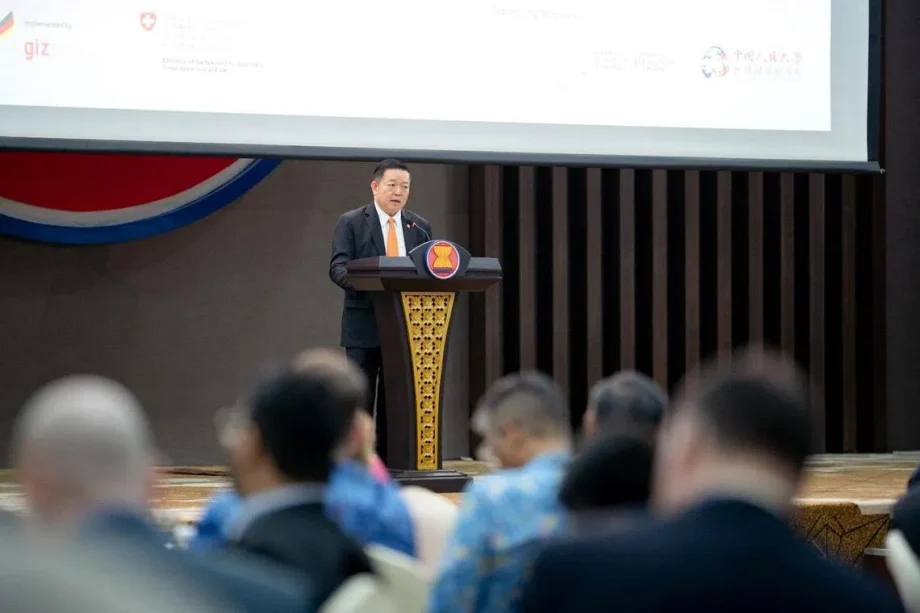
JAKARTA – ASEAN risks being sidelined as countries increasingly turn to smaller groupings to deal with security and other challenges, its Secretary-General Kao Kim Hourn warned on Sept 14.
With new alliances and partnerships proliferating across the Indo-Pacific, ASEAN must ensure that the regional institutions it has built over decades remain relevant and are able to bring countries together, he said.
“For ASEAN, the question is how to ensure that this increasingly complex regional architecture does not become so fragmented that ASEAN-led processes lose their coherence, relevance or convening power,” Kao said.
The issue will take on added significance in 2027, when Singapore takes over as ASEAN chair from the Philippines as the grouping marks its 60th anniversary.
Kao said the milestone should be an opportunity not just to celebrate six decades of regional cooperation, but also to ask whether ASEAN’s institutions and ways of working are still suited to a much-changed world.
“The test of its centrality will lie in what its institutions can achieve,” he said. “Centrality, after all, cannot rest on institutional inheritance alone.”
He was speaking to more than 150 diplomats, policymakers, academics and think-tank researchers at the opening of the third ASEAN Think Tanks Summit at the grouping’s headquarters in Jakarta.
The two-day summit was organised by the Singapore Institute of International Affairs on behalf of the ASEAN Institutes of Strategic and International Studies, a network of think-tanks from across the region.
Rising proliferation of sub-regional groupings
Kao’s remarks come as the security landscape around South-east Asia becomes increasingly complex, with countries turning to smaller groupings and partnerships alongside long-established ASEAN-led forums.
Read Full Article At Source