SINGAPORE – After the Japanese occupied Singapore in February 1942, all men and working women had to carry a pink labour identity booklet issued by the Labour Association.
These booklets from the Malaya Sumatra Romukanrikyokai allowed the military administration to track the adult male population and the availability of labourers.
Within months, residents were weighed down by other documents reflecting the harsh conditions of life: ration cards, bicycle registration cards and permits for buying condensed milk or cloth.
Chinese men aged 18 to 50 were screened at five inspection centres to determine whether they supported China or opposed Japan.
At those inspection centres, a single rectangular stamp would determine their fates.
Those who “passed” received the stamp on their documents, clothing or arms and were released. The rest were loaded onto trucks and taken to mass execution sites – a tragedy in Singapore’s history known as Sook Ching, meaning “to purge or cleanse”.
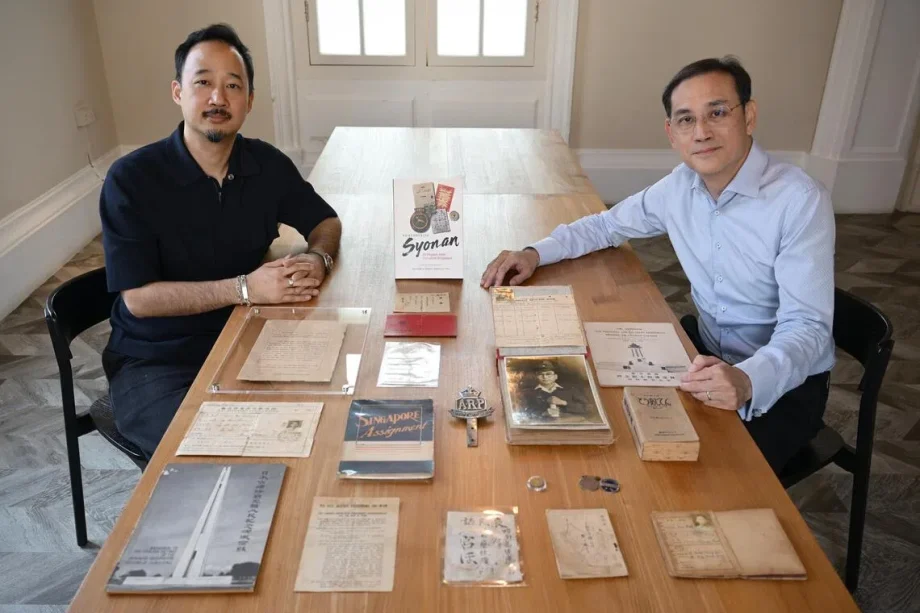
Such artefacts are featured in a new book, Remembering Syonan: 80 Objects From Occupied Singapore. It will be launched at the National Library on Sept 12 – exactly 81 years to the day after the formal Japanese surrender.

A certificate of registration with a rectangular stamp received at one of the Sook Ching inspection centres.
PHOTO: COLLECTIONS OF BENJAMIN SEET AND DOMINIC TAN
The book is co-authored by Benjamin Seet and Dominic Tan, avid collectors of artefacts from Singapore.
Some of the objects featured in the book come from a collection donated to the National Library Board in 2024 by Seet, who oversees innovation and research at the National Healthcare Group.
Amid a trove of academic work on World War II, the authors said their book stands out for its focus on the everyday lives of ordinary people.
“When you look at most history books… there’s a narrative that is chronological and typically, most of it would feature the politicians, the generals, the heroes, the people who have done great things in terms of war or nation building,” Seet noted.
“But when you look at this book, it is about everyday people.”

At its launch on Sept 12, the book will be sold at a discounted rate of $60 for a hardcover and $30 for a softcover.
ST PHOTO: NG SOR LUAN
The objects in their book offer a close-up look at ordinary life during the Occupation, beyond historical narratives.


Read Full Article At Source