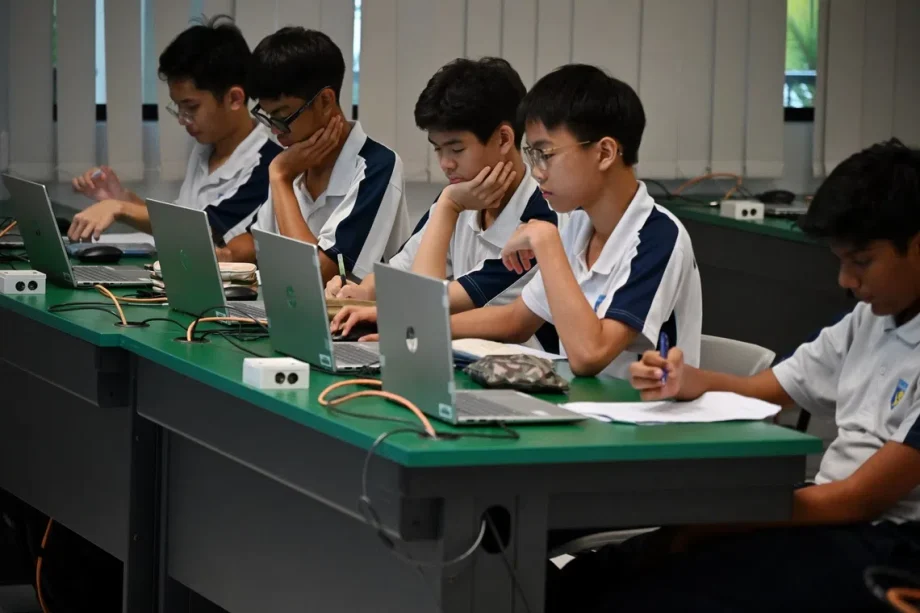
SINGAPORE – Singapore’s 15-year-olds have emerged among the top performers in an international benchmarking study to measure how well education systems are preparing students for complex challenges and the future.
The Republic came in first for reading, and second for mathematics and science in the Programme for International Student Assessment (Pisa) 2025, based on the performance of 6,551 students across 157 schools here.
Singapore was ranked second in computational problem-solving, a new section that evaluated how 15-year-olds break down complex tasks and design algorithms to solve real-world challenges.
A record 91 countries and economies took part in the latest assessment, up from 81 in the previous test in 2022. The latest study, which is done every three years by the Organisation for Economic Cooperation and Development (OECD), was released on Sept 8.
The Pisa 2025 survey focused on science, with mathematics and reading as minor areas. It also assessed for the first time learning in the digital world, measuring students’ capacities to build knowledge and solve problems using computational tools.
China and Singapore were the highest performers across science, mathematics and reading in 2025, with China leading in math and science, and Singapore emerging first in reading.
Estonia, Japan, Korea, Macau, Taiwan and Britain also ranked among the top 10 performing education systems in all three domains. Macau came out tops for computational problem solving, a new segment that assessed how well students can solve problems using computational practices such as analysing data.
The Pisa report noted that many parents still wrongly regard computer science as a specialist subject, useful mainly for aspiring software engineers.
“This is a mistake. The real value of computational problem solving lies not in coding itself, but in the habits it develops,” said the report, citing skills like logical reasoning, pattern recognition, and the ability to break complex challenges into manageable parts.
“These are becoming essential skills for a world increasingly shaped by technology and data.”


Read Full Article At Source