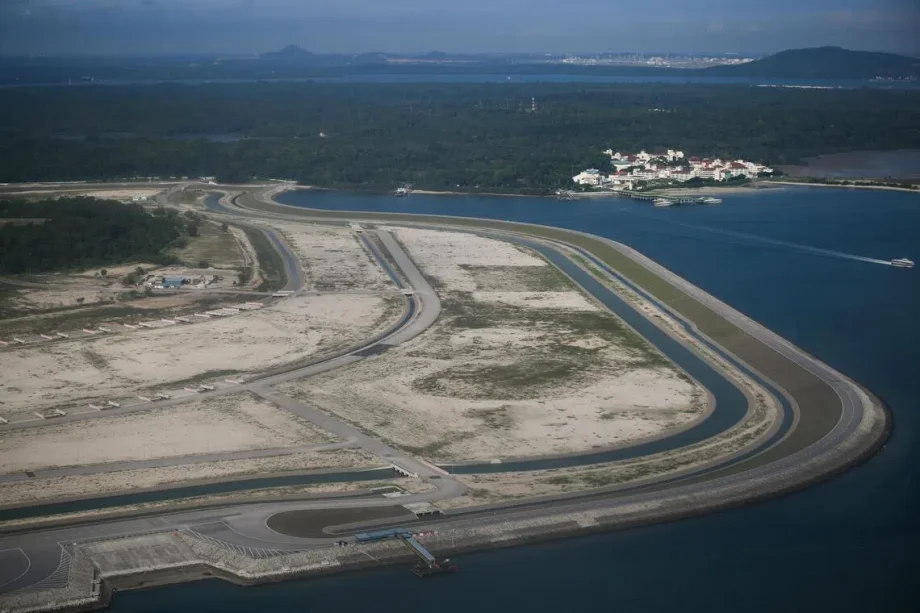
SINGAPORE – Completed in 2013, the Marina Coastal Expressway (MCE) marked a new first for Singapore, becoming the first highway in the Republic to have a segment running undersea.
Now, the Government is studying the feasibility of building more undersea tunnels – this time, to link mainland Singapore to Pulau Tekong, Singapore’s largest outlying island.
Engineers told The Straits Times that the planned tunnels are likely to be constructed differently from the MCE’s undersea stretch, and unpacked the possible considerations before the project can be green-lit.
How was Singapore’s other undersea tunnel constructed?
The MCE has a 420m section that lies 14m under the seabed of Marina Bay, or about 20m below the mean sea level.
A “cut and cover” method was used for the undersea section, which involved creating a dry dam for the tunnel to be built in, before constructing the tunnel and then covering the worksite.

Aerial photograph of the Marina Barrage (bottom) and the construction progress of the Marina Coastal Expressway (top), taken on July 14, 2012.
PHOTO: ST FILE
After the tunnel was completed, surrounding water was released and allowed to flow over it.
Chew Soon Hoe, deputy head of the Department of Civil and Environmental Engineering at NUS’ College of Design and Engineering, said the undersea stretch of the MCE could be constructed at a relatively shallow depth as there is no vessel traffic passing over it.
He added that the seabed at the MCE site has a more uniform soil profile than the channel between Changi and Tekong, which made “cut and cover” the optimal solution, as it could be carried out after the seabed was strengthened by deep cement mixing – a process that involves mixing cement with on-site soil.
This “cut and cover” solution, he said, is unlikely to be used for the mainland-Tekong tunnels as they will need to be longer and constructed deeper below the seabed, and as vessel movement will be impacted during the construction phase.

A “cut and cover” method was used to construct the undersea portion of the Marina Coastal Expressway.
PHOTO: ST FILE
Chew added that soil conditions in the Changi-Tekong area are more complex than at the MCE site, which makes deep cement mixing to stabilise the worksite more challenging.
Based on satellite images, the sea between Changi and Pulau Tekong spans at least about 1.5km.
How might the tunnels be constructed?
Engineers said that broadly, two construction methods can be used – tunnel boring or an immersed tunnel.


Read Full Article At Source