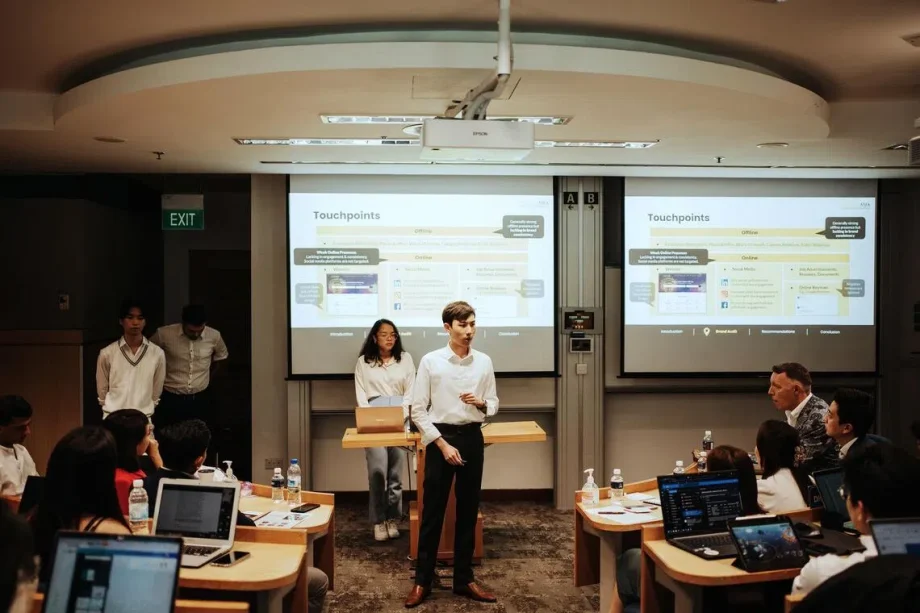
SINGAPORE – In a seminar room at the Singapore Management University (SMU), a professor is assessing a student as he delivers a live pitch to the class about an app he developed that guides users through a healthy grieving process.
After the student’s five-minute presentation, he has to tackle queries lobbed at him from fellow students and the professor during a question-and-answer segment.
A peer asks him if the app caters to a user’s unique emotional needs. He explains how the app asks users about what they are feeling each day, before determining the support they need.
This session makes up 30 per cent of the final grade for the management communication module. Other components include weekly reflections, and essays done either in class or online with a lockdown browser that prevents students from visiting other websites.
The professor at the session is evaluating the students’ understanding of concepts and their ability to spontaneously respond to questions without relying on a prepared script.
In previous years, the professor had graded students based on essays and projects submitted at the end of the term.
Elsewhere in SMU, another professor, Michelle Lee, is watching over students in her sustainable marketing class, as they write their essays in 15 minutes, without any materials to refer to.
They were given the essay question two weeks earlier, and were allowed to use AI to do research and formulate their answers.
But by having students write the essays in class, Lee said she is able to see whether students can put together a well-formed essay based on their research and understanding of the essay question, instead of using AI as a shortcut.
Tertiary educators have been moving away from traditional assessments like essay submissions to come up with creative ways to evaluate students.
This is a shift that is increasingly necessary as AI use becomes more common and even encouraged in universities.
“We have to be more creative in thinking up less straightforward ways to test students. Like a problem scenario where there are no easy answers, and AI will not be able to tackle it or answer in a perfect way,” said Lee.
This issue was thrust into the spotlight in 2025, when three public policy and global affairs students at the Nanyang Technological University (NTU) were penalised for misusing AI, resulting in false and inaccurate citations in their submitted essays.
NTU and the Singapore University of Social Sciences (SUSS) said in August that they will stop deploying detection tools to flag for AI misuse in students’ work.
The National University of Singapore (NUS), Singapore Institute of Technology (SIT) and Singapore University of Technology and Design (SUTD) also told The Straits Times they do not use such tools.
SMU said deploying detection tools is just one of the ways it detects AI misuse.
Christian Wolfrum, NTU’s deputy president and provost, said AI-detection tools served a reasonable purpose when universities were navigating AI’s uncharted territory, after OpenAI released ChatGPT in November 2022 and students began experimenting with it.

Read Full Article At Source