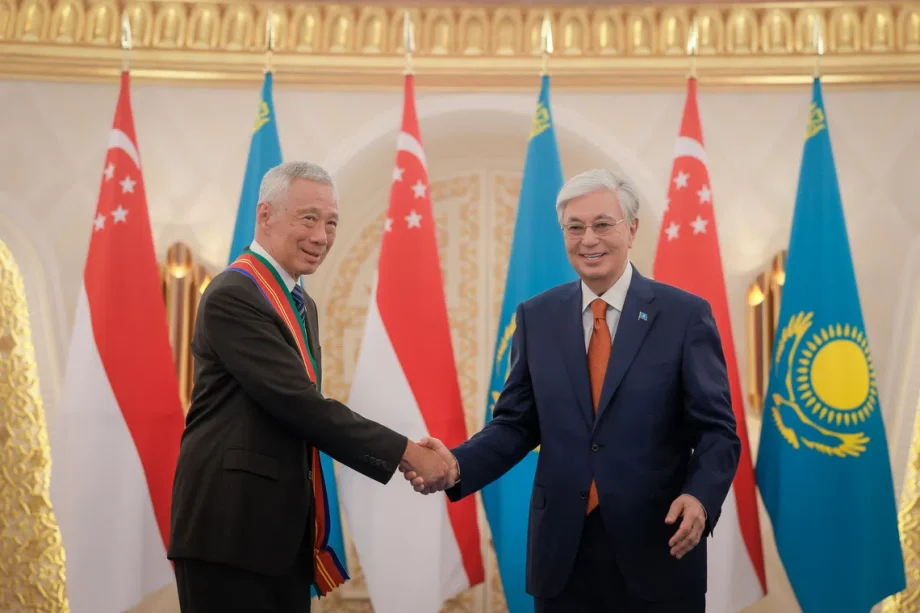
ASTANA – Singapore will explore ways to deepen ties between South-east Asia and Central Asia when it takes over as ASEAN chair in 2027, as it looks beyond the grouping’s traditional partners and towards a region with growing economic potential.
Senior Minister Lee Hsien Loong said on Aug 26 that Singapore would explore how the two regions could step up cooperation in areas including transport, connectivity, energy and sustainable development.
“As ASEAN Chair next year, Singapore looks forward to creating more opportunities for ASEAN to engage partners beyond our traditional networks,” said Lee at a ceremony in Astana, where Kazakhstan President Kassym-Jomart Tokayev conferred on him the Order of Dostyk, or Friendship, of the First Class.
“We will explore how South-east Asia and Central Asia can work more closely together.”
The award is a Kazakh state honour recognising contributions towards strengthening friendship and cooperation. Lee said he accepted it on behalf of the many Singaporeans and Kazakhs who had worked to bring their two countries closer together over the past three decades.
The push to strengthen links between the two regions comes as Singapore and Kazakhstan expand their own cooperation into new areas, with agreements signed on Aug 26 covering the digital integration of a major Eurasian trade route and water management.
Under the first agreement, the Singapore Cooperation Enterprise (SCE) and Kazakhstan-based transport and logistics company Middle Corridor Multimodal will work together on the digital integration of the Middle Corridor, a trade route connecting China and Europe through Central Asia and other areas. Experts say it has grown in importance as conflicts disrupt other routes between the two markets.
Potential areas of cooperation include trade documentation, multimodal logistics and supply chain management, said SCE. The partnership could also create opportunities for Singapore companies in digital trade, logistics and related services.
In an interview on Aug 26, SCE chief executive Kong Wy Mun described the link-up as a “very strategic alternative” for the flow of goods, with volumes growing by about 30 per cent each year.
But the route crosses several countries with different Customs standards and processes, which can create bottlenecks. Kong said Singapore could share its experience to help improve Customs interoperability and the efficiency of goods moving across borders.
“Our companies would certainly benefit in terms of possibilities of getting projects in this particular region and area,” he said, adding that these could provide a platform for them to expand further into Central Asia.

Read Full Article At Source