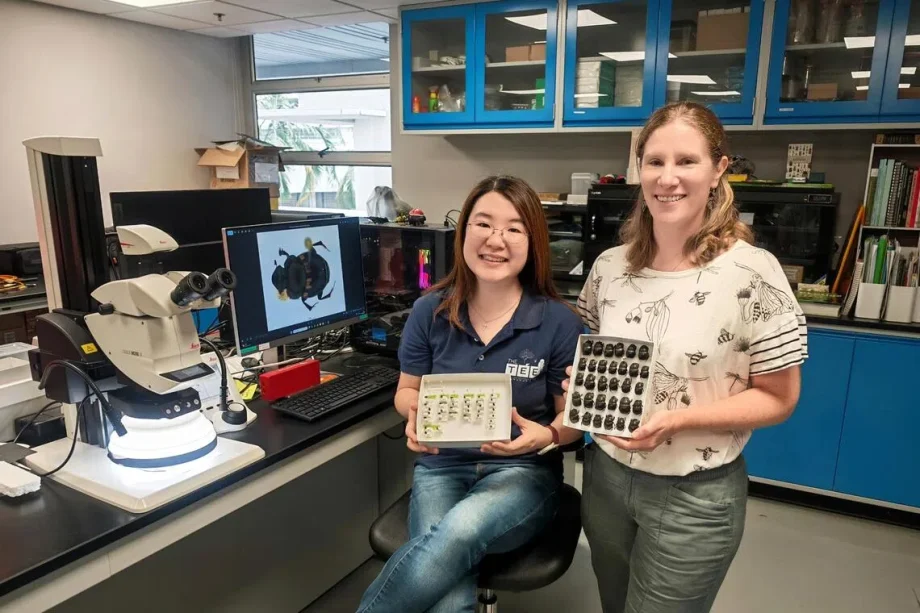
SINGAPORE – Deep in the Central Catchment Nature Reserve, shiny black beetles roll animal dung for their food and nests, and some navigate with the light of the Milky Way.
New research has proven that dung beetles not only help to break down animal faeces, but that their unusual diet can also give clues about the elusive mammals and birds that roam the forests.
These tiny but mighty insects can help to fortify biodiversity surveys that currently rely on camera traps, and assess the health of forests.
Between January and March 2023, an NTU team led by associate professor Eleanor Slade and research fellow Ong Xin Rui placed 100 traps made of plastic bottles and disposable plates on the forest floor and canopies across 50 sites in the Central Catchment Nature Reserve – Singapore’s largest green lung.

Ong Xin Rui (left) and Eleanor Slade preparing a trap using plastic bottles and disposable plates at one of the 50 sites of the Central Catchment Nature Reserve. Slade is holding bait made of human faeces wrapped in a thin cloth, to attract dung beetles to the trap.
PHOTO: NTU
To lure scuttling dung beetles into the traps, the scientists placed a bundle of human faeces, wrapped in cloth, at each trap. Harnessing their strong sense of smell, dung beetles are particularly drawn to human waste.
Each trap was left in the field for 24 hours before the researchers returned to collect the beetles. Tropical dung beetles typically move around 100m a day, stopping to slurp nutrients inside animal droppings.

A trap with a plastic bottle dug into the soil to catch dung beetles, and a disposable plate overhead. The bait hangs under the plate to lure the beetles.
PHOTO: NTU
Slade, who heads the Tropical Ecology and Entomology Lab at NTU’s Asian School of the Environment, said: “The dung beetles will have been flying around and eating dung that’s in the forest, and we’re just using (the bait) to draw them in, and then they land. But their guts are full from what they’ve been eating previously.”
Their stomachs would contain a mush of mammal and avian DNA that the scientists sought to identify.
Ong said: “The main objective of this study was to draw the interactions between the dung beetles and the types of vertebrate or mammal dung they were feeding on.”
More than 540 dung beetles belonging to 14 species were trapped over two months, with the contents of their guts analysed in the lab.


Read Full Article At Source