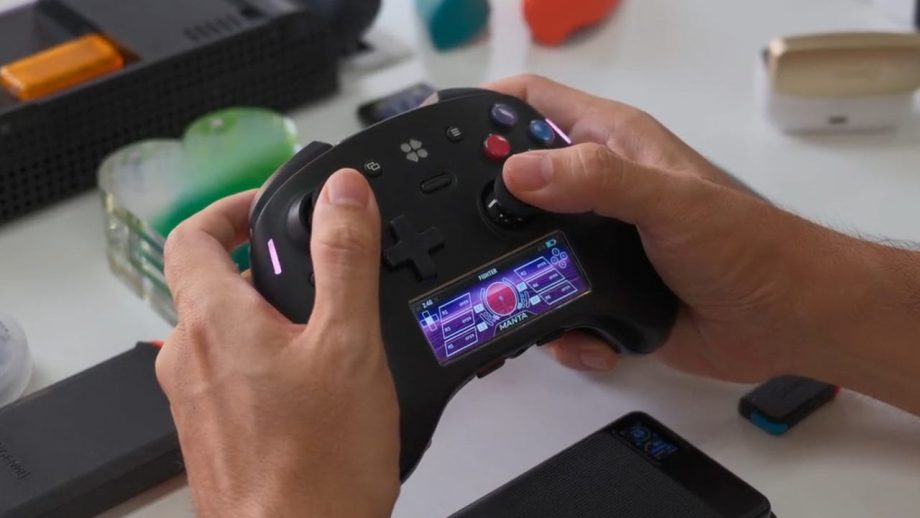
Genki, maker of some of our favorite accessories for the Switch 2 and Switch, has launched a Kickstarter for what might be the most over-engineered controller I’ve ever seen – and for $279, it better be. The Genki Manta packs in the kind of cutting edge features found on the best controllers out there, like TMR sticks, adjustable triggers, and advanced haptics, as well as even more advanced tech like a full-blown operating system, complete with digital display, built into the controller itself.
Now, I’m all for hardware and peripherals that incorporate new tech and push their categories forward, but I’m not quite sure why anyone would need a controller this advanced. It’s undeniably well-designed – I appreciate the screen centered below the thumbsticks, instead of above like on the Turtle Beach Stealth Ultra, and how the tension of the thumbsticks can be dialed in (literally) on the fly by twisting the stick itself. But at some point you have to ask if we’re approaching the point of overkill.

Genki is taking a bit of a kitchen sink approach with the Mantra. “We refused to cut corners,” the Kickstarter reads. “It is, frankly, a spec monster.”
Compatible with PC via USB-C wired or 2.4 GHz wireless (via USB dongle) as well as Switch 1 and 2, mobile, and other devices via Bluetooth, the Manta has a standard Xbox-style layout with offset sticks and all your standard inputs. It has a 2,400 mAh user-replaceable battery, but there’s no mention on the Kickstarter page of an estimated usage time between charges. Blessedly, it can remotely wake a paired Switch 2.
The face buttons are “Analog Pulse Buttons” that track through their entire travel when pressed, not just when they bottom out, allowing users to adjust their actuation point anywhere between a quick rapid-reset for burst inputs and a deeper one that calls for a deliberate press. Similarly, the triggers have three distinct modes: Digital, which offers a short travel and crisp click, Rapid, which is fully analog but with a short, smooth travel, and Analog, which offers a full, smooth travel and proportional control.
Read Full Article At Source