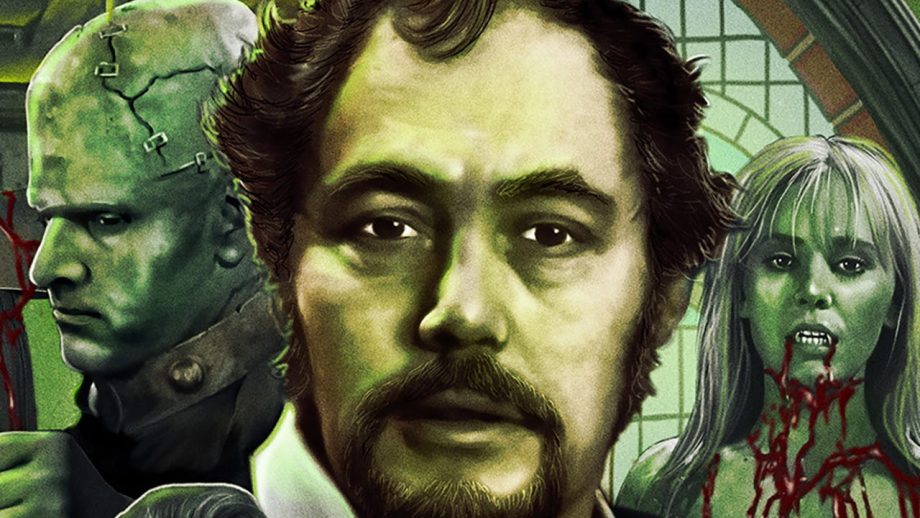
In the early ’70s, UK-based Hammer Films was winding down after defining a creative and colorful era of horror with lavishly produced films featuring lovely ladies, lethal living dead, and copious amounts of red, red blood. But even though their greatest years were behind them, the company that made Christopher Lee and Peter Cushing genre icons still had a few devilish delights to offer audiences before they reached the end of that dirt road in their runaway carriage (either 1976 for their last horror film, To the Devil a Daughter, or 1979, when they released their actual last film, Hitchcock remake The Lady Vanishes). One of the men most responsible for writing many of the movies that shaped Hammer’s style, Jimmy Sangster, even got a chance to direct during that final decade of Hammer’s classic output, and although the three films he helmed (two of which he also co-wrote, while the other — Lust for a Vampire — was scripted by Danger: Diabolik and Barbarella’s Tudor Gates) are not generally regarded as among the best the studio produced, they each have charms all their own and deserve reappraisal.

Now Severin Films is giving us that opportunity with their first-ever release of Hammer titles — Sangster Directs Hammer is an impressive set that brings The Horror of Frankenstein (1970), Lust for a Vampire (1971), and Fear in the Night (1972) to the US in 4K UHD for the first time, all wrapped up in a gorgeously gory green box. As usual for Severin, these movies have never looked this vibrant. Hammer was always well known for its lurid palette and stunning visuals, but now they practically leap off the screen. Fortunately, Severin also knows that preserving the true film experience is important, so grain is not absent but a wonderful texture layer along with everything else. One minor tweak: The box would perhaps be better named Sangster Directs Hammer’s Ralph Bates, because that actor — who forged a productive creative partnership and lasting friendship with the director — appears in all three films, and the story of their collaboration is the spine running through the patchwork body of material presented here. As for the extraordinary extras curated and collected to accompany the films — including a 312-page book! — there couldn’t be a better sign of the love and respect that everyone involved has for these movies and the creative team that made them.
Sangster was an endearingly self-deprecating man who, in his autobiography Do You Want It Good or Tuesday, titled the chapter on these three films “They Would Have Been Better Directed by Terry Fisher” (referring to the legendary Hammer director who helmed multiple entries in their Frankenstein and Dracula series starting with the first installments in 1957 and 1958 respectively). We’ll never know if that would actually be true, but that doesn’t mean these movies are the failures Sangster and others believed. Most folks apparently shuffle these to the bottom of their lists pretty quickly; the fact that Severin was only able to produce this box because no one else wanted to license these titles is baffling to me, but a boon for us and them. And no, I’m not saying these are classics on par with the films that launched Hammer’s legend, but they’re solid productions with something to offer both Hammer aficionados and casual fans alike. Let’s take a closer look…
The Horror of Frankenstein (1970)
Of the many tactics Hammer employed to distinguish their cinematic monsters from the unforgettable 1930s-1940s Universal incarnations that preceded them, one of the cleverest and most inventive was to follow the creator rather than the creature when making their series of Frankenstein films. And I know it’s blasphemy to many Hammer fans (appropriately enough) but this comedic remake of Hammer’s first Frankenstein foray (1957’s The Curse of Frankenstein) and the next-to-last installment in the seven-film Hammer Frankenstein series — with Ralph Bates replacing Peter Cushing as Victor — is my favorite of that entire run. While Cushing plays an utter sociopath or a more genial amoral Victor well (there are two timelines in the series; it’s complicated), Bates perfectly blends the sociopathy with a glib devil-may-care charm that makes him delightfully magnetic. Hammer was trying to make Bates a thing, positioning him as Frankenstein, Dracula (plans for that went awry when Christopher Lee came back instead, relegating Bates to a smaller role in 1970’s Taste the Blood of Dracula), and Dr. Jekyll (in 1971’s Dr. Jekyll and Sister Hyde). While things didn’t quite pan out, what we have is wonderful for all of us who value what Bates brought to the slab.
The film is ahead of its time with its black humor and gleeful lewdness; it feels like partial inspiration for the Re-Animator movies, and its lascivious tone resembles what people often thought all Hammer movies were like but weren’t. The sexual dynamics are interesting too, as Victor’s friend, Stephan (Stephen Turner), eagerly becomes his cook and wants very much to be part of Victor’s life, while the movie makes clear that a man working in the kitchen seems unusual to everyone. They also joke about Victor not being interested in men…or is he? He shows zero interest in Elizabeth (Hammer regular Veronica Carlson) even when she virtually proposes to him, and although he carries on with housekeeper Alys (the superb Kate O’Mara), that could be more about continuing a power dynamic established by his father rather than personal desire.
In a cute twist on Frankenstein tropes, Victor keeps track of creature assembly via a build-by-numbers approach. His friend Wilhelm (Graham James) even hits the nail on the flattop by speaking a version of the clichéd line: “You’re tampering with forces we don’t fully understand!” As for the creature itself, David Prowse (yes, Darth Vader) is a mute, hairless Karloffian monster with a creepy smugness that suggests he’s far smarter than his predecessors. He’s no tragic figure either; this creature’s a violent bastard. As the bodies mount up, Victor is willing to let those around him suffer if it means protecting his creation; the apple didn’t reanimate far from the tree.
The only disappointment is an abrupt ending that leaves you wanting Bates-led sequels, but it wasn’t to be; when Hammer tried one more time to draw on Shelley’s creation for movie material, they brought Cushing back. But we have this one, and it’s a twisted delight.
Lust for a Vampire (1971)
After mining Stoker for over a decade, Hammer turned to Sheridan Le Fanu’s sapphic classic novel, Carmilla, for inspiration, resulting in a trio of films focusing on a female vampire first played by Ingrid Pitt in 1970’s lush and top-heavy saucy romp, The Vampire Lovers. Lust for a Vampire is the second installment in what would later be labeled “The Karnstein Trilogy,” and it featured several missteps, not least replacing Pitt as Mircalla/Carmilla with Yutte Stensgaard. Yutte’s no Ingrid, but she’s also not as bad as some think. She does a damn good job of conveying that underlying air of menace and calculation that makes Carmilla a great villain; she just isn’t quite as good or as stylish as Pitt was.
Read Full Article At Source