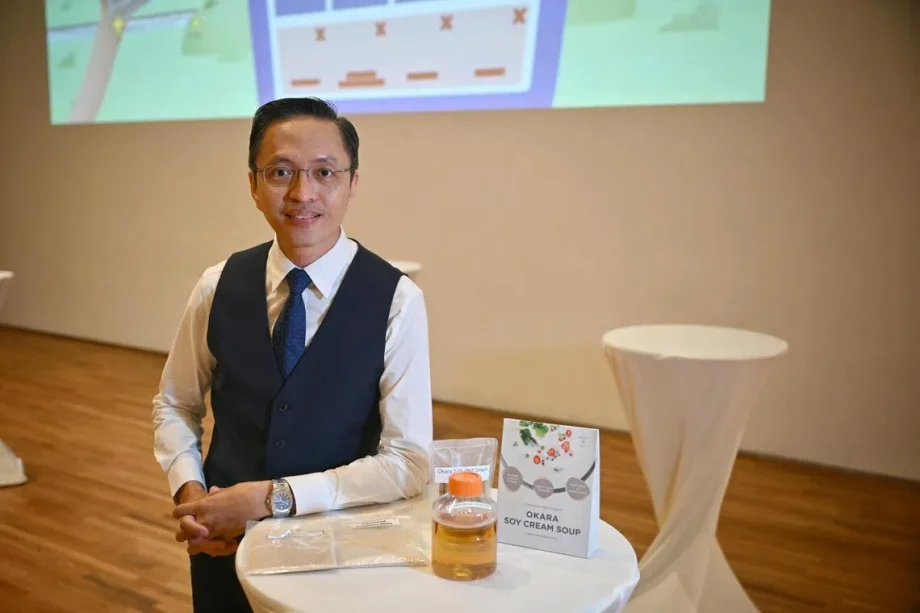
SINGAPORE – To squeeze value out of leftover soya pulp that would otherwise go to waste, food scientist Heng Kiang Soon developed ways to turn it into ingredients for human food and agricultural use, among other products.
The pulp, called okara, which is generated after producing soya milk and tofu, is rich in protein and fibre, but it is indigestible by humans and often discarded.
Determined to maximise “every resource we already have” in a resource-scarce country like Singapore, Heng developed a technology to make the ingredient soluble and turn it into 14 food and agricultural products like soya cheese, soya cream soup and plant boosters. The plant boosters, which are known as biostimulants, can enhance crop yield and quality.
Some of these products have been licensed for commercialisation, said the specialist in food innovation and lecturer at Republic Polytechnic’s School of Applied Science.
On Aug 18, Heng was among 14 people presented with the EcoFriend award, which recognises individuals from the private and public sectors, educational institutions, grassroots and non-governmental organisations for their significant contributions to making Singapore more sustainable.
He estimated that the production of plant boosters as well as soya cheese, instead of using commercial raw materials, could have substantial cost savings.
Converting by-products like this into useful products is not only environmentally friendly, but can also help to generate new business opportunities and build stronger food system resilience, said Heng, who grew up on a farm in Malaysia.
“If we learn to see waste not as something to throw away but as a resource with untapped potential, we can unlock solutions that benefit both society and the environment,” added the 50-year-old, who is also looking to recycle other food waste like spent coffee grounds and fruit pulp.
Organised by the National Environment Agency, the 17th edition of the biennial EcoFriend Awards was held at National Gallery Singapore.


Read Full Article At Source