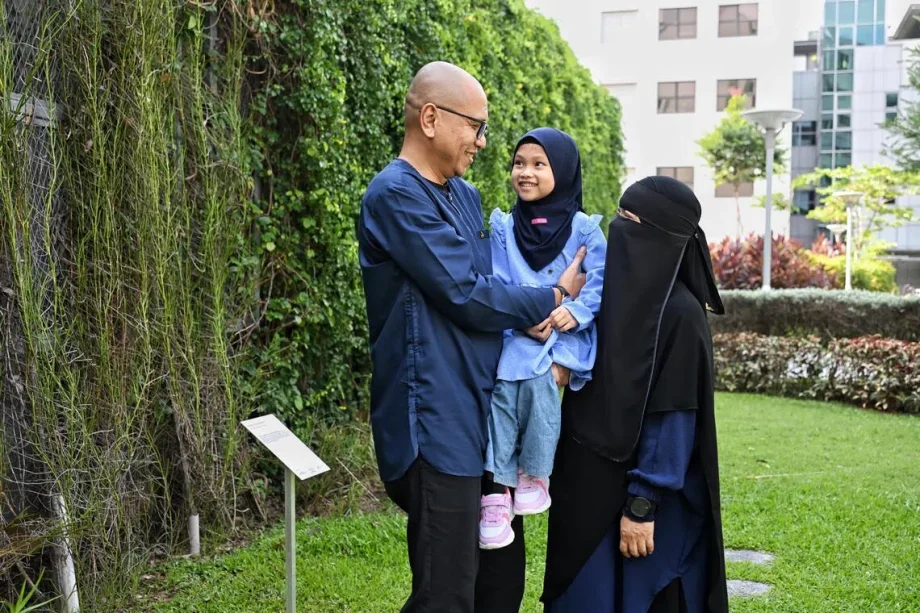
SINGAPORE – When homemaker Siti Abdillah heard her baby cry after she gave birth to her by caesarean section in 2020, she thought everything was fine.
“Then the room went very quiet before the doctors and nurses started whispering. They rushed Sumayyah out of the operating theatre and summoned my husband in,” the 46-year-old mother of five said.
Her husband, Abdul Rahman, 45, said that when he first set eyes on his daughter, he thought she was still “dirty with afterbirth”.
“But when I looked closely, I was shocked by what I saw,” the patient relations associate at a hospital said.
Sumayyah was born without skin on nearly 40 per cent of her body.
All she had was a membranous covering over her scalp, torso and four limbs through which doctors could see her organs and blood vessels.
Sumayyah, now five, has aplasia cutis congenita (ACC), a rare birth defect in which a baby is born missing layers of skin on a localised area of the body. It affects about one in 10,000 births.
ACC most frequently appears as an open, ulcer-like wound or thin membrane at the top of the scalp, though it can affect the limbs or torso. Babies born with ACC in its extensive form, with large areas of missing skin, may not survive.
Singapore General Hospital (SGH) neonatologist Alvin Ngeow said: “To our knowledge, (Sumayyah) is a survivor with the largest extent of missing layers of skin in Singapore. You can imagine that in place of her skin, there is the transparent membrane that looks like cling wrap.”
He said the thin membrane in place of skin on Sumayyah’s head was so transparent that her brain was visible through it, “and that was worrying”.
A baby’s skull is made of several bones joined by flexible sutures and soft spots called fontanelles, which allow the skull to flex during birth and expand as the brain grows.
Ngeow said: “It was through the fontanelles that we could see her brain underneath. Unfortunately, there were minute breakages in the ‘cling wrap’, and that meant there was a possibility of complications such as an infection that could be life-threatening.
“Right in the middle of the brain is a huge blood vessel called the sagittal sinus, and once it bleeds, it is very difficult to stop (the bleeding)… A (third) feared risk is called brain herniation, which is when the brain is pushed outwards through a weak spot.”
The doctor said it was good that Sumayyah was delivered through a caesarean section instead of natural birth. Otherwise, her brain might have herniated.
“We had to prevent all three scenarios from happening in a quick and decisive manner, or we would very likely lose her,” he added.


Read Full Article At Source