The problem with nostalgic AI images of old Singapore

The problem with nostalgic AI images of old Singapore


Doomscrolling on Instagram recently, I came across what looked like a photograph of the former Jurong Entertainment Centre (JEC). The image appeared hyper-realistic – its distinctive facade, with its blue-grey palette and Shaw Brothers “SB” signage, immediately stood out – before it started to feel “off”.

This Jurong East staple, which had shut down in 2008, held many core memories from my teenage years. The stale buttery scent of popcorn-stained cinema seats. The hand-painted dinosaur mural flanking the main escalators. The cold blast of air walking into the ice-skating rink. The final moments I spent with a budding relationship that was over before it had begun.

Those days were defined by the twang of heartache and innocence, a bittersweet bite of nostalgia – feelings stirred up by old photos. 

But this digital likeness of JEC left me with only a creeping sense of unease. The building’s exterior looked impossibly sleek; the surrounding foliage was a shade of green too alien; and a motorcycle parked near the traffic junction stuck out like a misplaced Adobe Photoshop layer. 

Whatever this entity was, it was cosplaying as the once-beloved shopping mall, hoping no one would spot the difference. In that moment, the only nostalgia I felt was for a time before we filtered – and began to erode – our historical memory through the lens of generative artificial intelligence.

Can AI creations be authentic?

More visuals circulated within online communities paying homage to Singapore’s heritage are AI distortions of actual archival images or entirely AI-generated recreations of the past.

In a phenomenon known as nostalgia farming, social media pages churn out polished, synthetic visuals of Singapore’s lost icons. The Wisma Atria aquarium and outdoor patio at McDonald’s at Shaw House are classic engagement bait that gets commenters reminiscing about the good old days.

Creators rarely act in bad faith. Many believe AI can help preserve heritage and drive appreciation for the past by making old places feel vivid again.

An actual photograph taken on 5 Nov 1986. Shoppers viewing the fish inside the cylindrical aquarium in the basement of Wisma Atria.

Shoppers viewing fish inside the cylindrical aquarium at the basement of Wisma Atria on Nov 5, 1986.

PHOTO: ST FILE

The moderator of Facebook group Heritage SG Memories, Simone Lam, uses an AI colouriser on photos of the past, including originals from the National Archives of Singapore. The tool transforms black-and-white photos into “clearer” colour images, “especially to help older members see details better and reconnect with precious memories”, Lam says.

AI-colourised images of old Singapore from Facebook group Heritage SG Memories.

Another creator, Zhengquan Qin, who is behind the AI-edited visuals of @sgtimetravel on Instagram, explains: “If I could carefully remaster an old archival photo, preserve the original scene and apply very light animation, then even for just five seconds, it could create a small but authentic ‘time travel’ experience.”

With black-and-white photos, he researches “plausible original colours” and, where possible, verifies them with older relatives. Any animation of a still photo is kept to five seconds. Any longer, the AI model hallucinates details, he says.

“Historical authenticity” is crucial, he stresses, aware that people who have experienced the place are key stakeholders. “Once AI adds random objects, changes signs, invents people or alters the mood of the place, it breaks the illusion and the memory no longer feels authentic.”

I believe their earnest intentions. Yet, it was on @sgtimetravel that I chanced upon JEC’s doppelganger – identical in every detail, yet utterly unrecognisable.

There are also few differences between AI-enhanced images and AI-generated ones. Unlike standard photo editing, which modifies existing pixels through human direction, AI automatically imagines new ones from scraped data. So, even when it intends to restore the past, it rewrites it.

What we lose

While creators and audiences mean to pay tribute to Singapore’s heritage, the opposite likely happens.

Human memory is reconstructive – we constantly negotiate between what happened and how we now understand it. But AI papers over the subjective, individual experiences and visual imperfections that make a place memorable.

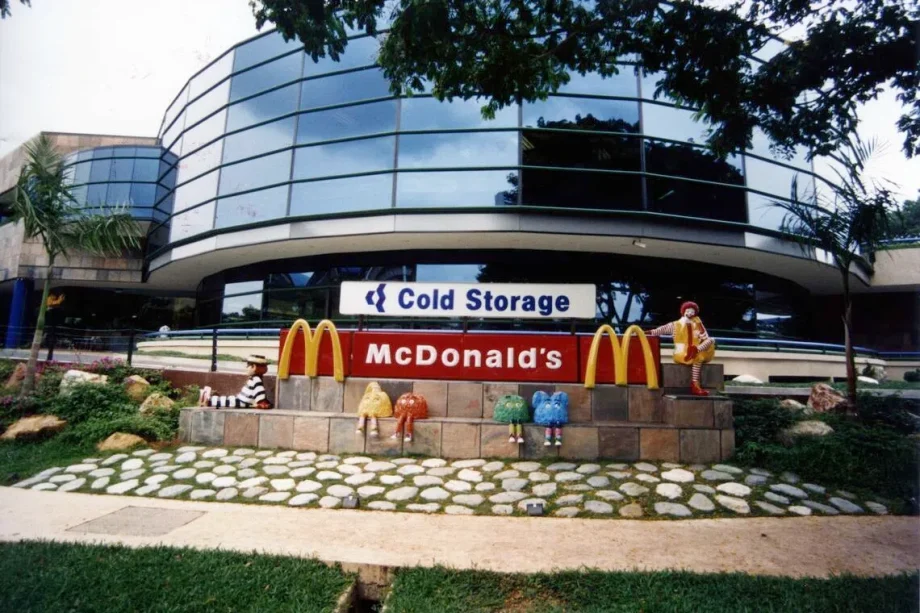
For instance, it hasn’t yet captured the cigarette stubs and mouldy fries often wedged between the McDonaldland statues at the old King Albert Park McDonald’s, or the unspoken camaraderie among students from Bukit Timah schools who would cram for exams there.

AI nostalgia slop, in effect, causes a “double loss” of these places: first, to time and progress, and now, to a cultural flattening. Its homogenising effect also suggests that history must fit a specific aesthetic to be worth remembering.

The biggest tell is the uncanny valley effect: The final creation often looks familiar, but feels foreign. My colleague Teo Kai Xiang, who has written about the local heritage creators producing legitimate educational content, says AI nostalgia slop comes across as being composed by an alien that is learning about human life second-hand, but has never seen it in person.

Some old-timey recreations of Singapore are riddled with inaccuracies – gibberish signage, phantom storefronts – that the casual viewer readily overlooks. Sentimental resonance usually matters far more than historical truth.

I have also felt this sensation in the broader surge of Y2K-themed nostalgia. Think digital simulations of teenage bedrooms with the glow of MSN Messenger, a dial-up modem’s high-pitched screeches and dog-eared boy-band posters – elements that, together, belong to a caricature of the past rather than a memory.

Understandably, such dissonance might not matter to many, with some seeing this content as “the only good use of AI”. 

As AI improves its ability to recreate the past, I fear our own capacity for discernment will fade. In time, not only may we become unable to tell what’s real from what’s rendered, but we may also not even care that slop is warping our memories.

By embracing AI’s rose-tinted version of the past, we may risk losing something far more intrinsic and irreplaceable than our heritage. We give up what makes us human.

Missing: Humanity?

To be sure, AI slop, in general, leads to such loss.

The most common example is prose that’s too perfect. There is zero sense that the writer has struggled to finesse their muck of thoughts over and over again – an unskippable step in producing writing worth reading.

But this soulless void seems more apparent in AI-rendered nostalgia than anywhere else, because these imitations of vanished places and landmarks are supposed to ignite the same layered ache for a simpler time that archival footage inspires.

True memory-making is a sensory, unmistakably human endeavour, built on the actual labour of someone having lived through something. There is an Eternal Sunshine Of The Spotless Mind lesson here: Our memories, including the painful ones, aren’t flaws to be corrected, but essential parts of who we have become.

An AI representation of a place is the antithesis of this. It isn’t where actual humans formed actual memories, just a projection of what AI thinks we remember.

Of course, some may argue that AI slop may be fake but still evokes valid emotions. There are case studies of AI supposedly changing the way people grieve, like using it to emulate a dead person’s voice to help their loved ones cope. The argument is that the ends justify the means. 

But the means we choose fundamentally alter the ends. A manufactured sense of presence creates only a manufactured sense of closure. AI nostalgia slop offers a cheap hit of sentimentality as artificial as its source, which in the long run atrophies our ability to mourn the inevitable cultural loss that comes with development. It costs us the inexplicable sense of knowing that what we’re seeing was once real.

And as heritage is inherently tied to loss, any honest preservation of it demands we feel this grief fully, too – even if it means we eventually forget something that existed, rather than cling on to what never did, like an AI-generated reimagining of it.


Read Full Article At Source

Share. Save. Don't Miss The Buzz: XFacebookRedditLINETelegramWhatsAppGmail