SINGAPORE – He loved running through the park every evening and ballroom dancing, but a pinched nerve in his lower back put a complete stop to these activities for Teo Seow Heong.
“The pain started in my lower back, and then my left leg became numb. It did not feel like that was my leg,” said the retired precision engineer, 75.
“When my family and I went on a holiday in Thailand, I had difficulty walking.”
The first doctor Teo consulted referred him to a physiotherapist, who said he needed to exercise and stretch.
“It did not work at all and the pain continued. In fact, my left leg started losing feeling and I could not walk for a long time,” Teo said, adding that that was when he was referred to neurosurgeon Thomas Tan.
Tan, a consultant neurosurgeon with the National Neuroscience Institute (NNI), put Teo through a battery of tests, including a magnetic resonance imaging scan, or MRI, and found that his condition was a result of spinal degeneration.
“I wanted to continue my active lifestyle, so I told Dr Tan to ‘fix’ me as soon as possible. What I had in mind included screws and metal plates. Instead, I was told it would be a small cut and that I would be totally conscious throughout,” said Teo.
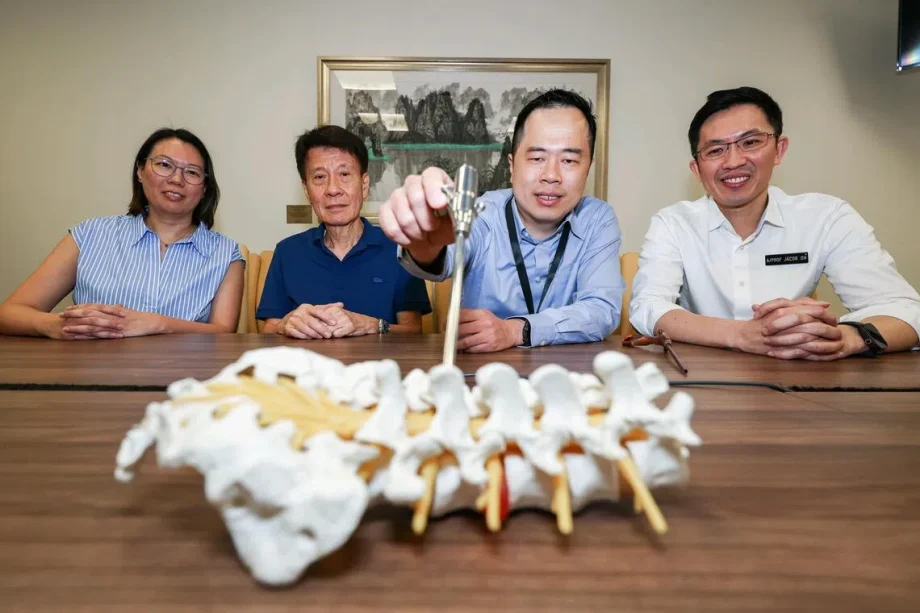
What Teo was describing was a procedure called “awake endoscopic spine surgery”, where surgeons treat conditions such as a narrowed lower back that pinches nerves, damaged spinal discs and nerve compression in the mid-back. This is done through keyhole incisions while the patient remains conscious throughout.
Such procedures are gaining traction here because they lead to faster recoveries and decrease post-operative pain. They are also a better option for elderly or high-risk patients, who are often denied traditional surgery owing to anaesthesia-related complications.
Jacob Oh, head of spine surgery at Tan Tock Seng Hospital and clinical director of NHG Spine Centre, said awake endoscopic spine surgery is carried out using local anaesthesia with light sedation rather than general anaesthesia (GA).
“It lowers the risks of GA. It prevents side effects such as nausea and vomiting, muscle aches, breathing issues and mild confusion… Post-surgery, patients do not feel groggy. It is almost like they just came from a dental treatment,” he said.
Oh added that previously, when patients asked if they could do spine surgery under sedation instead of going under GA, the answer was always “no”.
“We did not want them to move because we are operating right next to the nerves… But with today’s technology and better equipment, this has been made possible,” he said.


Read Full Article At Source