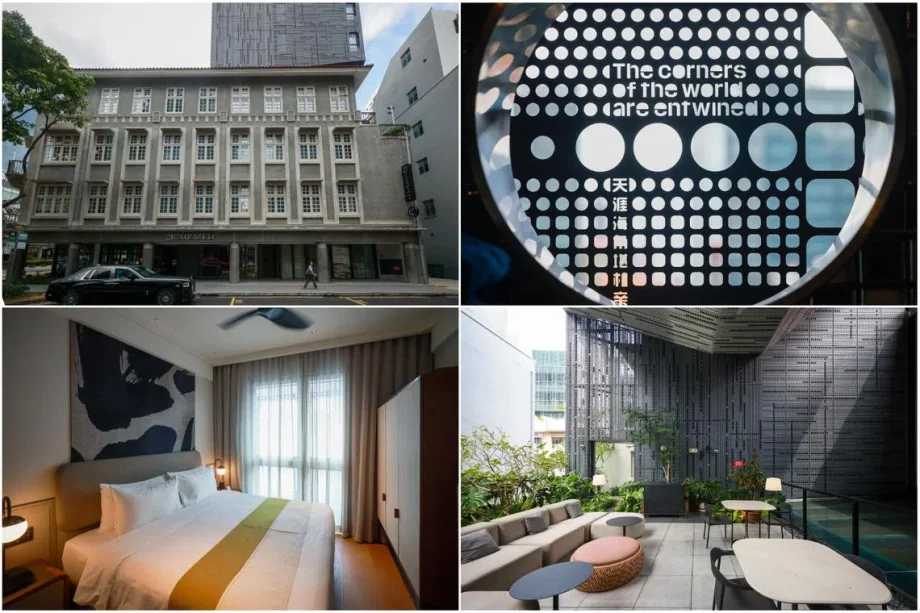
SINGAPORE – On the fringe of Chinatown stands 21 Carpenter, once a remittance house for the Teochew diaspora and now imaginatively redesigned as a modern heritage hotel.
The boutique hotel is named after Carpenter Street, part of the Teochew sub-enclave within Chinatown, so the streets around the 1936-founded shop would have mirrored scenes from the movie of the moment, Dear You.
The hit Teochew film now showing in Singapore cinemas has resonated with audiences with its story of a struggling migrant worker in Bangkok’s Chinatown and his wife in rural Shantou, China, linked by decades of letters.
In the family drama, young trishaw rider Zheng Musheng (Wang Yantong) writes about a rising moon “round as a jade pendant”, wishing his wife, Ye Shurou (Wang Xiaohui), could admire it together with him.
Singapore’s labourers, who would have experienced the same separation and heartache, sent letters and money home through the Chye Hua Seng Wee Kee remittance shop that forms the bones of 21 Carpenter.
Woha Architects has translated that local history of grief and grit into architectural poetry. The hotel’s sleek facade is laser-etched with 24 lines from archival letters across its aluminium skin. Running horizontally in English and vertically in Chinese script, one inscription reads: “My words overflow the page.”

A scene from the Dear You movie, where the young Ye Shurou (left, played by Wang Xiaohui) listens as a friend reads aloud a poignant letter from her husband working in Bangkok’s Chinatown.
PHOTO: GOLDEN VILLAGE
Richard Hassell, co-founding director of Woha, tells The Straits Times: “The facade design draws on old Chinatown itself, when shopfronts were covered in carved signs and inscriptions – we wanted the new building to carry that same sense of being ‘read’ as you walk past.”
Collected from the National Archives of Singapore, the poignant verses are also embedded across the lifts, social spaces and 48 guest rooms of the hotel, which opened in December 2023 and was named Design of the Year at the President’s Design Award 2025.
Many Chinese labourers could not read or write, so their words were composed by educated street scribes. “These writers often reached for classical poetry – lines everyone at the time would recognise, and instantly know what feeling they carried,” adds Hassell.

Lines from remittance letters written by immigrants are laser-etched onto the facade and interiors of the 21 Carpenter hotel.
ST PHOTO: JASON QUAH
Ink and memory
The motif of writing repeats at different scales throughout the property. The carpets and headboards draw on calligraphy, for instance.
In the lobby that features warm, rich chengal wood floors and railings salvaged from the original structure, the carpet draws inspiration from the Chinese character 家 (jia), meaning home or family.
In the corridors, the custom carpets are woven in stark black and white, evoking the strokes of a calligraphy brush.


Read Full Article At Source