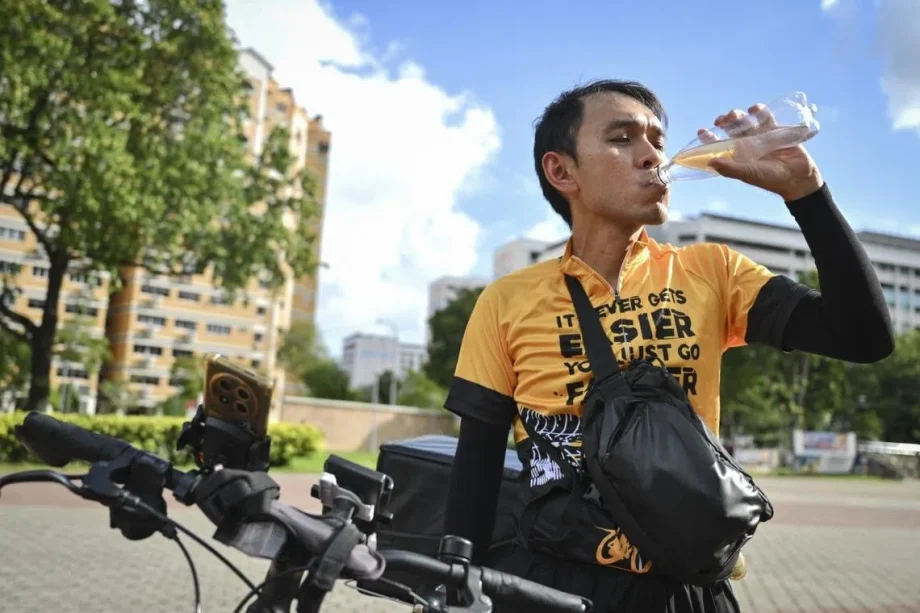

Delivery rider Kelvin Zeng, 43, spends most of his days drenched in sweat.
For the last five years, he has cycled around Tampines and Simei almost daily, delivering food to residents from around 8.30am to 8.30pm.
Aside from lunch and brief lulls between orders, he is usually on the move.
Lately, though, the heat has become harder to endure. Zeng says he has taken more breaks to hydrate over the past month, stopping at Our Tampines Hub and community centres to refill his bottle.
Twice – on particularly hot days in March and May – a splitting headache forced him to end work two hours early.
But there is no respite at home; heat follows him inside.

Kelvin Zeng cycles almost daily to deliver food around Tampines and Simei, working long hours under the sun.
PHOTO: CAROLINE CHIA
He shares a five-room Housing Board flat with his parents, in their seventies, and children, aged 13 and 11. Without air conditioning, he has been sweating through the night, losing sleep three to four times a week in June. By morning, fatigue slows his delivery pace, he says.
The reduced pace and more frequent breaks shave three to four deliveries off his daily average of 30, he estimates, cutting his earnings by around $14 to $19 every day.
For Zeng, the worry is not just the heat he faces now.
Meteorologists warned that the mercury may continue to rise. A stronger version of El Nino is forecast for later this year, potentially bringing drier, hotter conditions to South-east Asia.
El Nino is a weather pattern where trade winds weaken and warm water shifts eastward across the Pacific, raising sea surface temperatures in the central and eastern Pacific. It last occurred in 2023 to 2024.
“I’m (especially) concerned if (intense) heat drags on and I’d need to take longer breaks,” says Zeng, who believes climate change is contributing to warmer temperatures.

Food delivery cyclist Kelvin Zeng says hotter days means more breaks and greater fatigue, cutting three to four deliveries from his usual 30.
PHOTO: CAROLINE CHIA
His experience is not uncommon. A survey of 1,000 Singapore residents suggests that heat is increasingly affecting people’s lives and well-being. They ranked hotter weather and heat stress as their top concern arising from climate change.
Conducted in April 2026, the survey was commissioned by SPH Media and Temasek Foundation, with respondents drawn from Kantar’s Profiles Audience Network. Kantar is an independent market research firm.
Eighty-two per cent of them said heat stress disrupts their daily lives at least once a month. Of this, about half said it happens at least weekly.
Forty-six per cent of people reported excessive sweating and dehydration due to heat, while 41 per cent experienced fatigue, and 39 per cent poor sleep.

Eighty-two per cent of survey respondents said heat stress disrupts their daily lives at least once a month.
ST PHOTO: BRIAN TEO
Heat strains and drains
Delivery riders face higher heat risks due to prolonged sun exposure and pay tied to speed, potentially discouraging them to slow down or take breaks, says Associate Professor Jason Lee, director for Heat Resilience & Performance Centre at NUS’ Yong Loo Lin School of Medicine.
What we are concerned about is a ‘hot body’, or heat strain, not (just) a hot environment,” says Lee.
Heat strain occurs when the body cannot remove excess heat, causing internal temperature to rise.


Read Full Article At Source