For decades, Singapore’s economy revolved geographically around a single downtown core centred on the Central Business District and the civic district. As the city grew, policymakers sought to decentralise jobs and commercial activity to regional centres to mitigate strain on the transport system and moderate peak-hour congestion.
Jurong Lake District (JLD) is the most advanced and ambitious expression of that vision, first revealed in 2008 as part of the Urban Redevelopment Authority’s draft masterplan. The Town Hall Link site in the new JLD precinct, with a flexible land zoning designation, will be released for sale in July 2026, along with eight other residential sites scheduled for launch under the Government Land Sales programme in the second half of 2026.
This marks another step in the transformation of JLD into Singapore’s largest mixed-use business district outside the city centre, and perhaps the country’s most important urban development project in the coming decade.
How much hinges on Jurong’s successful transformation cannot be overstated – as a strategic economic project and a test of whether Singapore can indeed create a second major employment node outside the downtown core that brings jobs closer to homes and boosts liveability in the west.
What makes JLD significant is not simply its scale but what it represents as a new model of mixed-use across residential, office, commercial and leisure spaces, for how Singapore can grow in an era of land constraints, changing work patterns, and the need to create new economic opportunities beyond the traditional central business district.
The idea of decentralising commercial activity is admittedly not new. The 1991 Concept Plan envisioned four regional centres in Jurong East, Woodlands, Tampines and Seletar to distribute jobs and economic activity more evenly across Singapore. But Jurong East regional centre takes that idea one step further.
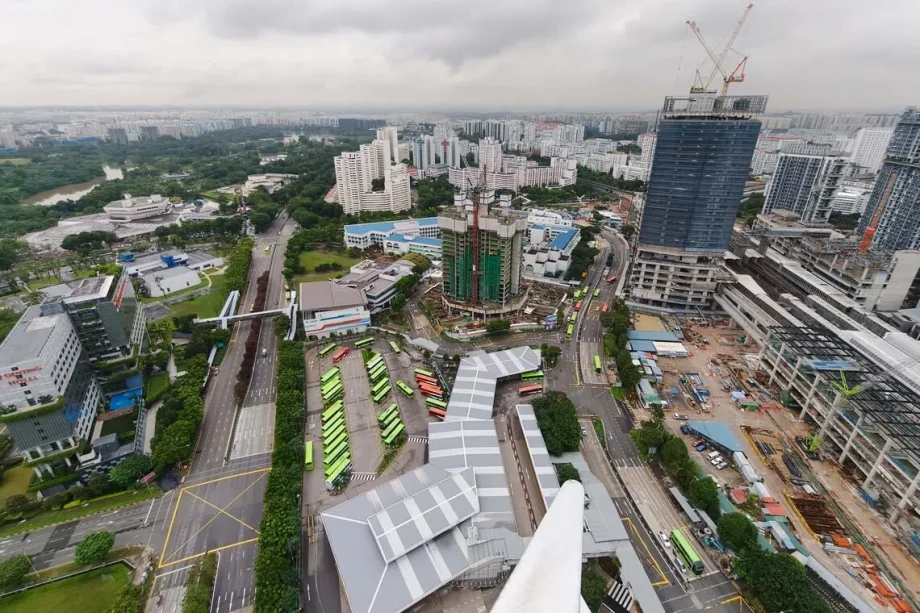
The Town Hall Link site is the first “white” site launched within the new 120ha Jurong Lake Central precinct in JLD, adding new mixed-use space on top of the commercial cluster around Jurong East MRT station. This white zoning sets the envelope based on the density of a development site, but gives developers the flexibility to curate the optimal mix of uses within that envelope and partner with the Government to shape the land into a choice location for businesses, quality housing and recreational facilities.
The Town Hall Link site illustrates the ambition behind JLD. As a mixed-use “white site”, it gives developers the flexibility to combine 40,000 sq m of offices, 1,200 private homes, and 44,000 sq m of complementary retail, hotel, recreational and community uses within a single development.
The Town Hall Link site also sits at the intersection of four MRT lines – the two existing North-South and East-West lines, and the two new MRT lines, Jurong Region Line and Cross Island Line Phase 2, expected to open in phases – and a new bus interchange at the Jurong Gateway Hub.
A high level of connectivity, with major transport networks to the rest of Singapore, is vital in anchoring the JLD and the future Town Hall Link development as a gateway for economic activity in western Singapore. The district will be 30 minutes away from the Central Business District and 50 minutes to the future Changi Airport Terminal 5 by MRT.
Meanwhile, an extensive network of multi-level pedestrian linkages, dedicated cycling paths and bus-only corridors within the wider JLD will connect homes, offices, retail, recreation and public facilities. The goal is to create an environment where people can live, work and play within a 10-minute walk-cycle-ride without having to travel to the city centre.

Read Full Article At Source