If you’ve never played Magic: The Gathering (MTG), the prospect of getting into it can seem pretty daunting. This is a game, after all, with 30+ years of history. That’s more than three decades of cards and mechanics, worldbuilding and lore. If you’ve ever lived and breathed a live service video game you’ll know just how much energy and time it can take simply to keep up. Constant new releases and updates that drive an ever-evolving meta mean it can be tricky to be even a casual fan… let alone finding your feet as a completely new player.
Magic: The Gathering definitely has many of the same challenges, but it also has more ways to interact with its cards and its history and its gameplay on your own terms. The fact that it’s mostly played as a physical game, for instance, means that it doesn’t necessarily matter what the best decks are, and what the most competitive players are doing. If you have a bad but fun deck and I have the same, we can still play and have a good time.
Wizards of the Coast has also been doing “Universes Beyond” content for more than five years now, and many of these releases essentially act as an onramp to Magic. Are you a fan of Final Fantasy? The Lord of the Rings? Avatar: The Last Airbender? There’s a Magic set for that. While many of these sets do have ramifications for the wider player base, they can be self-contained for those that simply want to try out MTG, without having to know any of the official lore or characters.
Magic’s gameplay still has a learning curve, of course, and every set is likely to have cards that require either a knowledgeable friend or a quick Google to decipher. Even so, a standalone Universes Beyond set is a pretty good place to start for the curious. All of which brings us to Marvel Super Heroes, the latest such release.
Super, Thanks for Asking
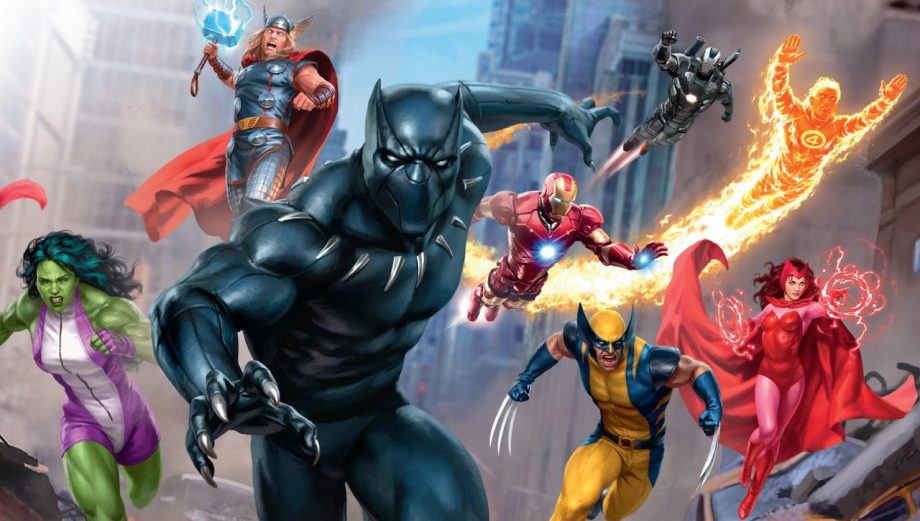
As an entry point for Marvel fans, this is about as welcoming as it gets. A great heaping helping of heavy hitters from the Marvel universe are here… in card form: Iron Man, The Hulk, Captain America, Doctor Doom, The Scarlet Witch, Black Widow, Daredevil, Thanos, Black Panther, Elektra, Ant-Man, Loki, Thor, Storm, Wolverine, Jessica Jones and Nick Fury, the list goes on.

The themes and mechanics are built to resonate with these characters and the settings they’re from too. There are Hero and Villain creature types, each with tribal synergy (meaning that heroes often get bonuses for fighting alongside other heroes, and villains have the same). There’s a keyword called Teamwork, which lets you utilise members of your team (i.e. creatures you control) to activate an additional effect.
Some characters – both good and bad – can “Power-up” once per game to trigger a strong additional ability. When “Thanos, the Mad Titan” powers up, for instance, not only does he get a stat bump, but you can choose odd or even and then destroy every other creature with a mana value of the chosen quality. Snap!
A small subset of characters come on dual-faced cards. On one side you might have Bruce Banner, the flipside, The Hulk. On this side Peter Parker, the reverse, Spider-Man. Each has value and you can choose which side to play, but you can also transform them mid-game, so Tony Stark can become Iron Man just in time to turn things around.
And no superhero set would be complete without villainous plots, which is where Plans come into play. These have conditions that typically take multiple turns to be met, but the longer the build-up, the bigger the pay-off. “Doom Reigns Supreme”, for instance, lets you play a couple of your opponent’s cards for free, while “Construct a Cosmic Cube” helps you spawn token creatures and eventually lets you take over and play your opponent’s turn!
Read Full Article At Source