Singapore key to US chipmaker GlobalFoundries’ quest to equip humanoid robots with AI

Singapore key to US chipmaker GlobalFoundries’ quest to equip humanoid robots with AI


SINGAPORE – As artificial intelligence breaks out of computer and mobile phone screens and takes physical form, chipmakers are increasing their focus on the hardware and technologies that will run robots and the infrastructure needed to support them.

Humanoid robots, widely considered the most revolutionary form of physical AI, are closer to mass production than many people realise. Such robots will need purpose-built semiconductor platforms to respond in real time and perform real-world operations.

At the same time, hyperscale data centres will have to contend with unprecedented traffic, which could spike bandwidth and power requirements to levels they are not yet capable of handling.

US chipmaker GlobalFoundries (GF), which has a large manufacturing footprint in Singapore and recently bought a local semiconductor firm, sees physical AI as the next big wave of innovation and a massive opportunity for the company to deliver energy-efficient, highly integrated chips and devices.

Gregg Bartlett, the company’s chief technology officer, said GF has been working on physical AI and related semiconductor technologies for several years, with the goal of fundamentally changing the company from being just a chips contract manufacturer to a more holistic technology provider.

Along the way, it has bought many smaller companies for their technology and manufacturing capacity, including Singapore’s Advanced Micro Foundry (AMF).

The 2025 acquisition has expanded GF’s silicon photonics technology portfolio, production capacity and research and development in the Republic. This complements the company’s existing capabilities in the US, unlocking new market opportunities and meeting the growing optical communication demands of AI data centres.

Bartlett told The Straits Times in an interview: “This is the perfect time for GF to have made these anticipatory investments in intellectual property and capabilities that will fuel this massive ramp-up that’s going to be happening in the next five years.”

Acquiring AMF has made GF the world’s largest pure-play foundry by revenue for silicon photonics that integrates optical and electronic components onto a single silicon chip, using light – or photons – instead of electrical signals to achieve ultra-fast and energy-efficient data transfer.

The move has also strengthened Singapore’s position as a trusted semiconductor manufacturing and innovation hub, and a critical node in the global chip-supply chain.

Bartlett said some early manifestations of physical AI are already commercially available in the form of autonomous vehicles, drones and robots.

Companies such as US electric vehicle maker Tesla, US robotics and engineering company Boston Dynamics and China’s Unitree Robotics also offer humanoid robots, which are so far limited in number and functionality.

Fully functional humanoid robots that will work in factories, construction sites and homes are not too far away, says GlobalFoundries’ chief technology officer Gregg Bartlett.

Fully functional humanoid robots that will work in factories, construction sites and homes are not too far away, says GlobalFoundries’ chief technology officer Gregg Bartlett.

But Bartlett said fully functional humanoid robots that will work at factories, construction sites and in homes are not too far away.

Bank of America (BofA) believes the population of humanoid robots – which can learn directly from the world, translate language into action and adapt to people in real time – is poised for a take-off.

BofA Global Research projects annual humanoid robot shipments will surge from 20,000 units in 2025 to 10 million by 2035. In 2026 alone, sales are expected to reach 90,000 as leading companies ramp up production capacity and scale deployments.

By 2060, the number of humanoid units in operation could reach three billion, surpassing cars on a per-capita basis, BofA analysts Lynelle Huskey and Vanessa Cook wrote in a recent research report.

While industrial and service applications are expected to lead adoption in the near term, the number of household humanoids that can help out with laundry, vacuuming, the dishes and other tasks is projected to accelerate quickly and ultimately account for the largest share, or 62 per cent, by 2060, they said.

Bartlett said sensing, thinking, acting and communicating are the core capabilities that make up any physical AI application, including humanoid robots.

That means a real-time operating model behind a physical AI system should be able to capture data from the physical environment using multimodal sensors such as audio, video, temperature, motion and environmental sensing.

It should also execute precise, timely actions through motors or actuators with precision feedback loops, as well as exchange data reliably and securely across distributed systems – from edge to cloud, and across devices.

To deliver these capabilities, GF has developed a host of technology solutions, such as an FDX platform for power management, and a differentiated FinFET platform for efficient sensing, real-time processing and seamless communication.

GF can also provide memory solutions including MRAM and RRAM, silicon photonics and radio frequency (RF) innovations that drive high-speed connectivity. The chipmaker also has the capability for advanced packaging that brings together diverse technologies into compact, efficient systems.

A GlobalFoundries semiconductor plant in Singapore.

A GlobalFoundries semiconductor plant in Singapore.

PHOTO: GLOBALFOUNDRIES

Its Singapore operations have played an important role in the development of some of these technologies, said Bartlett.

“Singapore has a vital role in physical AI, photonics, power, mobile, automotive and data centres,” he said. “All of these capabilities are centred here. It plays a really important foundational role for everything we do”

Singapore has had a central role in GF’s development and manufacturing of power management chips and devices. The company’s development of audio and haptic processors for mobile devices was also done here.

In 2023, responding to increased demand for power and battery-management systems, it expanded its fabrication plant in the Republic, creating new high-value jobs.

Bartlett said that as data centres now ramp up their processing capacity, there will be increased demand for integrated voltage regulators. “And that work is also happening in our Singapore facility.”

Additionally, GF’s advanced packaging solutions and RF systems – which are specialised semiconductor devices designed to transmit, receive or process high-frequency signals – are also part of its Singapore operations.

Bartlett said most of GF’s tech platforms for physical AI are also relevant today for scaling up generative AI and agentic AI applications. “Devices that you have today will start embedding true AI capabilities, whether it is apps or AI agents that are on your mobile device, or virtual-reality glasses,” he said, adding that the evolution to a world dominated by physical AI has already begun.

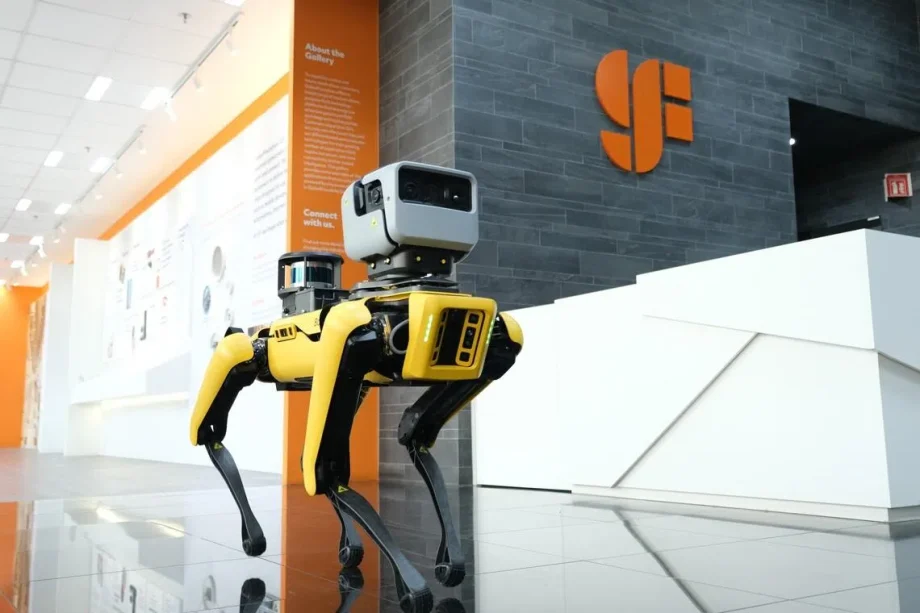
A Boston Dynamics robot “dog” at a GlobalFoundries chip fabrication plant in Singapore.

A Boston Dynamics robot “dog” at a GlobalFoundries chip fabrication plant in Singapore.

PHOTO: GLOBAL FOUNDRIES SINGAPORE

For example, a Boston Dynamics robot “dog” at a GF chip fabrication plant in Singapore helps maintain equipment by detecting heat signatures and reporting potential issues along with the recommended solutions.

As data centres continue to ramp up their processing capacities to run physical AI workloads, technologies like silicon photonics and advanced packaging will become critical, Bartlett noted.

Hence, Singapore will continue to play a crucial role in GF’s near- and long-term development plans, he said.


Read Full Article At Source

Share. Save. Don't Miss The Buzz: XFacebookRedditLINETelegramWhatsAppGmail