SINGAPORE – Five leopard cats were found to be living in the coastal forests of Changi after a survey running from July 2025 to April 2026 was conducted by volunteer-run non-profit Singapore Wildcat Action Group.
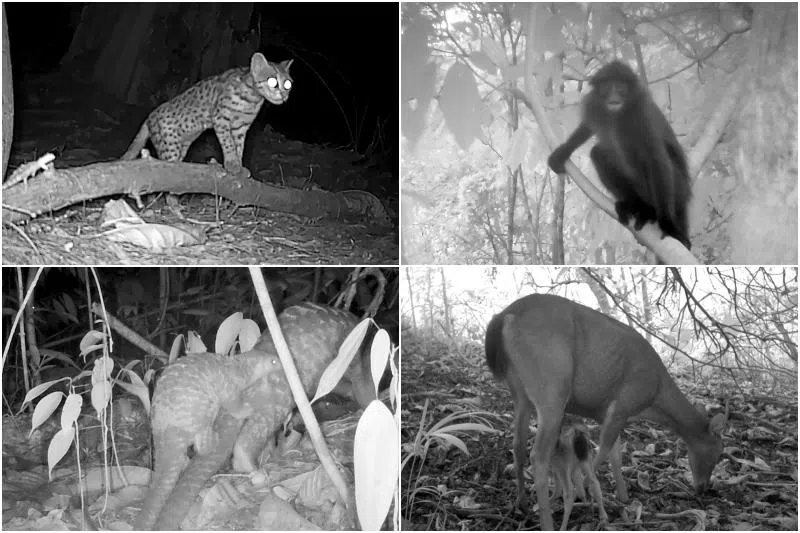
The survey involved 18 motion-sensor cameras placed along the coastline to track the nocturnal predators over the span of roughly a year. From grooming to hunting, the cameras captured the escapades of the felines, which are critically endangered here.
As a result, the authorities decided to relocate the animals to ensure their welfare and long-term survival, as the Changi landscape transforms.
Camera traps are commonly used by researchers and conservationists for a variety of reasons, such as estimating population sizes and studying wildlife behaviour, experts told The Straits Times.
Through these “eyes”, they are also able to monitor habitats with minimal disturbance and observe elusive species both on land and under the sea, with the information gathered contributing to conservation management efforts here.
For instance, findings can highlight hot spots of wildlife activity, which can inform where to prioritise protection or minimise disturbance, said Mandai Nature’s senior manager of local biodiversity Delaney Eng.
They can also guide habitat enhancement and the design of ecological infrastructure such as wildlife crossings.
Many camera traps used today are equipped with an infrared sensor which is triggered when a rapid change in temperature is detected, such as a warm-blooded creature walking past, said mammal scientist Marcus Chua.
These traps can be left in the field to monitor a habitat for weeks or even months, depending on battery life and storage capacity.

An adult male leopard cat named Asli can frequently be seen across the Changi coastline.
PHOTO: SINGAPORE WILDCAT ACTION GROUP
He added that other camera traps can also be programmed to take photos at timed intervals, or involve a trip wire or pressure plates, depending on whether a researcher’s target species is able to trigger the camera.
Camera traps function as an eye that can monitor a site round the clock, with minimal disturbance, said Chua, who is also a mammal curator at the National University of Singapore’s Lee Kong Chian Natural History Museum.
He first used camera traps in 2008 to survey terrestrial mammals on Pulau Ubin, he said, adding that the use of camera traps has been widespread since the 1990s. Since then, he has used them to study mouse-deer and leopard cats.
“The camera trap was one of the methods used to rediscover the presence of greater mouse-deer on Pulau Ubin, and then later estimate their population size and status there,” said Chua, adding that camera traps helped their understanding of specific overlaps in the diets of the greater mouse-deer and wild pigs on the island that were not previously known.
He also deployed an array of camera traps to monitor the distribution of leopard cats across mainland Singapore and estimate their population size. The findings were published in a study in 2016.


Read Full Article At Source