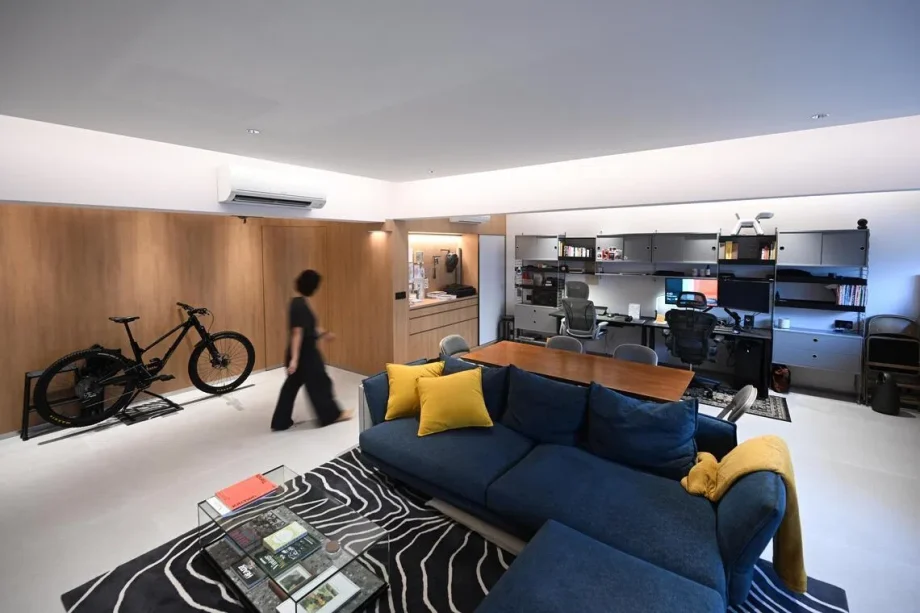
SINGAPORE – When married couple James Loh and Crystal Yeap, both 40, first viewed their four-room flat in Bedok in July 2023, they immediately knew that almost every wall in the home would have to come down.
Keeping the original floor plan from 1984 would have left them with a living room measuring 29 sq m, which the couple felt was too small for their lifestyle and preference for larger communal spaces.
They eventually removed the majority of walls in their home. While the decision left them with only one bedroom, it increased their communal living area by nearly 60 per cent to 46 sq m.
“In Singapore, homes feel like they are getting smaller and smaller, so having ample, comfortable space at home is something we appreciate,” says Loh, the creative director of commercial interior design company HeatherGrey Studio.
They are part of a growing group of Singaporean home owners rethinking conventional floor plans and hacking walls to create layouts that better suit their needs and lifestyles.
Between 2019 and 2025, Alexis Tan, director of boutique interior design studio Alexis Interior, has seen a more than 50 per cent increase in the number of clients willing to depart from the original layouts provided by the Housing Board (HDB).
“I think home owners are getting younger and more curious about what they can do in a space of their own. People are also getting more resourceful, so they have been getting inspiration from potential designs online,” she says.
The trend has also been reflected in public housing design. In October 2024, HDB introduced an open-concept option known as the White Flat layout under its Crawford Heights Build-to-Order (BTO) project in Kallang-Whampoa.
These beamless flats are delivered without walls separating the living and bedroom areas, giving home owners greater flexibility to configure the space based on their preferences. According to HDB, around four in 10 buyers at Crawford Heights have opted for the White Flat layout, with the project expected to be completed by September 2029.

A rendering of a White Flat layout by HDB for flat buyers who would like greater flexibility in configuring the living spaces within their flats.
PHOTO: HDB
Buyers who choose a White Flat receive a price reduction of $6,000 for a three-room flat and $8,600 for a four-room flat. Those who do not opt for the concept are provided with a default layout that includes bedroom walls.
In public housing flats, load-bearing walls cannot be removed and home owners must obtain the necessary approvals from HDB before any demolition works can begin.
The approval process typically takes between one and two weeks, although early submissions are recommended to account for unforeseen delays, says Tan. The cost of removing walls varies widely depending on the extent of the works and the materials involved.
Older flats tend to be built with brick and concrete walls, while newer BTO flats typically use drywall partitions. Brick and concrete structures require more labour and care to demolish, making them more expensive to remove, while drywall partitions can be dismantled more quickly and at a lower cost.
Tan estimates that hacking works in older flats can cost up to 30 per cent more than in newer flats built with drywall.
Legal professionals Fiona Ng and Tan Shao Wei, both 29, moved into their BTO flat in the Bidadari neighbourhood in November 2025.
To make the most of the 69 sq m three-room unit, they tore down the majority of its walls, transforming it into a one-bedroom studio with just a glass-brick feature wall separating the living and sleeping areas.
“The glass bricks let light in, so the house looks a lot more spacious. And we really like the aesthetics of the material,” says Ng.

A glass brick feature wall separates the living room from the bedroom in married couple Fiona Ng and Tan Shao Wei’s Bidadari home.
ST PHOTO: SARAH LEE
Their decision was shaped in part by their previous living arrangement. Before moving into the flat, the couple had lived in an 83 sq m one-bedroom rental condominium unit for three years, and the shift to a significantly smaller home was difficult to adjust to, says Ng. It became one of the main reasons they decided to open up the space.
Room layout psychology suggests that the perception of space impacts feelings of freedom and mental clarity. Research has shown that increased natural light and ventilation in a home contribute significantly to mood elevation and higher life satisfaction.
“I think it’s really important to take into account comfort and how you feel about the space. Our flat just didn’t feel as comfortable because we came from a larger space, so hacking most of the walls made sense for us,” says Tan Shao Wei.


Read Full Article At Source