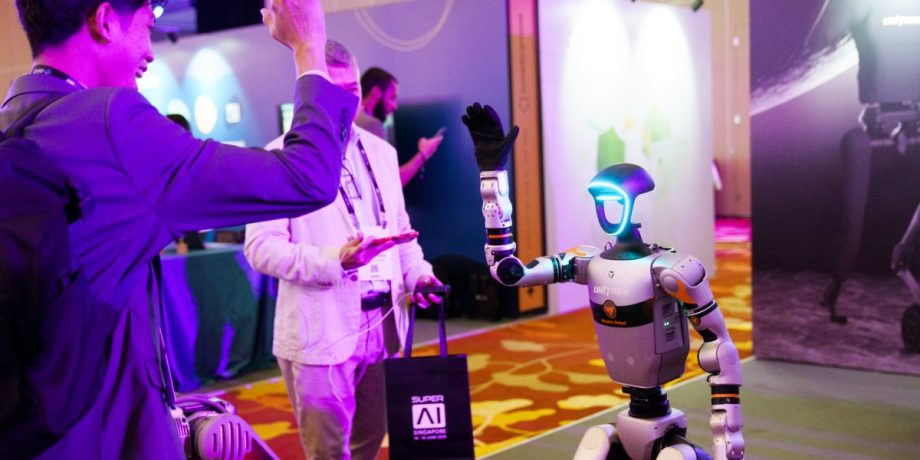
Singapore has spent decades selling the world on the promise that it can be trusted by all sides. For a new generation of AI companies, that pledge has never been more valuable.
OpenAI and Google DeepMind both established applied AI labs in the city-state over the past year, while Anthropic began advertising local positions in finance, product support, and economic research. Chinese firms like Tencent have also deepened their investment in the country.
“All the AI companies I work with, whether they’re from China, Korea or Japan, all use Singapore as a hub,” Gunja Gargeshwari, the chief revenue officer of Israel-headquartered web scraping firm Bright Data, told Fortune on the sidelines of the SuperAI summit in Singapore. “It’s easiest to operate in the region if I have people in Singapore—it’s where conversations are happening, and where the innovation hubs for different providers are being set up.” Bright Data, for instance, has chosen to position Singapore as its APAC headquarters, even though 60% of its Asian customer base hails from China and India.
“We have the chance to stand out here,” said Nathan Xu, the CEO of San Francisco-based AI notetaker company Plaud. “Unlike many companies that originate entirely from the U.S., if Plaud can position ourselves aggressively in Singapore, then we’re a cool company to prospective users across the globe.”
Plaud hired its first Singapore-based employee in 2024. On June 10, the company said it would spend 10 million Singapore dollars ($7.8 million) to expand its local operations. It also plans to grow its headcount from 100 to 150 by the end of the year.
Singapore’s appeal to the AI industry is as much due to geopolitics as economics. The country markets itself as an economic safe haven, with a long track record of regulatory clarity and strong governance.
“Some say we are boring, and we will never have the same offerings as New York and Paris,” Singapore Prime Minister Lawrence Wong said during a policy conference last July. “But at the same time, we are stable, we are predictable. We are reliable and we are trusted, and these are intangible assets that others would die to have.”
Founders like Xu also point to the country’s rigorous education system as an incubator for tech talent. “The biggest pain for me and the company is hiring the best engineers, and what’s interesting about Singapore is that it’s home to some of the best universities in the world,” Xu explains. (In this year’s QS World University Rankings, the National University of Singapore ranked #8, while the country’s Nanyang Technological University came in at #12.) “It’s a place which curates generations of talents around software engineering, computer science, AI, data science and operations.”
Read Full Article At Source