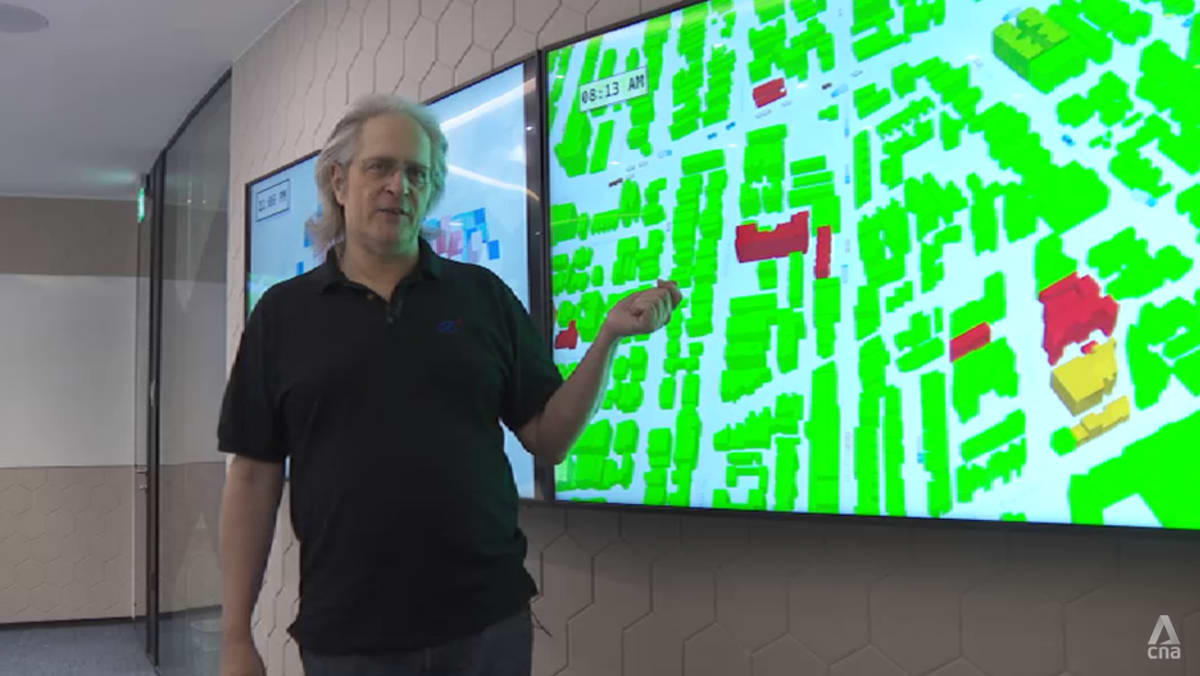
The simulation also accounts for differences in driver behaviour – some motorists may prefer fast chargers to quickly continue their journeys, while others may opt for slower chargers near their homes and charge overnight.
Rather than relying on current petrol station usage patterns, the model simulates how drivers are likely to adapt to different charging options and locations.
“This allows agencies … to model scenarios that are of interest, test their plans and see how well they’ll work (so as) to predict in a more realistic way what charging demand is going to look like,” Dr Farber said.
He added that future versions of the simulation could help urban planners evaluate different township and neighbourhood designs before they are built, allowing them to anticipate future energy demand and determine what infrastructure upgrades may be needed.
MORE LIVEABLE NEIGHBOURHOODS
The use of geospatial technologies extends far beyond transport and energy planning.
The National University of Singapore (NUS) will be launching a new geospatial intelligence major in August under its Bachelor of Science Cross-Disciplinary Programme to prepare students for careers at the intersection of geography, data science and computing.
“Geospatial intelligence is mainly for extracting actionable insights so (we) could address real-world problems,” said Associate Professor Feng Chen-Chieh, programme director for geospatial intelligence at NUS’ Department of Geography.
Read Full Article At Source