Translated by Candice Chan, Grace Chong

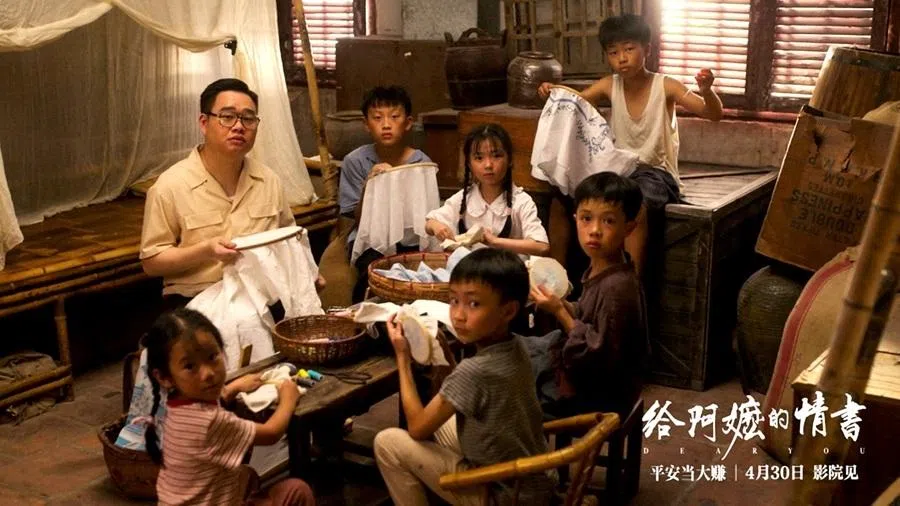
Seeing affordable airfares at the end of March, I booked a flight to Chaoshan for early June. My plan was to take a few days off to eat, drink and unwind, but I happened to travel just as the movie Dear You (《给阿嬷的情书》) was taking China by storm. So, on my second morning in Shantou, I headed straight to the cinema to catch the film in its original Teochew dialect.
This low-budget production has pulled off a remarkable feat, becoming a box-office sensation across mainland China. Following the publication of a column in Lianhe Zaobao (LHZB), the film also began attracting attention in Singapore much earlier than it otherwise might have. A slew of commentaries sprang up covering various points of view, including articles critiquing other commentators.
The film is director Lan Hongchun’s final instalment in his Teochew-dialect family trilogy. Before my trip, I did a bit of homework and watched the first two films, Proud of Me (《爸,我一定行的》) and Back to Love (《带你去见我妈》). The first chapter revolves around a father and the second around a mother. Both are fairly conventional hometown stories — engaging and entertaining, but not especially moving. The final chapter, however, focuses on a grandmother, delivering a profound emotional impact that sets it completely apart from the first two films.
Many have yet to see the film, so I will avoid spoilers — I would rather leave everyone to experience this simple, heartfelt story rooted in Chaoshan culture for themselves. What I want to discuss instead is why so much noise emerged afterwards, distracting attention from the film itself.

The first wave came after my colleague, Sim Tze Wei, watched the film in Beijing and wrote a piece on Dear You, exploring its implications for China’s United Front work. While I don’t entirely agree with her view, it was a personal column meant to offer her own perspective. It is only natural for such a strongly worded article to spark debate, especially given the sensitive nature of the issues it touches upon. What was troubling was that what followed did not resemble a healthy exchange of views — it felt more like the author and LHZB were thrown into a boxing ring and getting beaten up.
Using Open Source Intelligence (OSINT) techniques, I reviewed the social media activity around the article and found that within 48 hours of the column’s publication on 21 May, attacks on LHZB and narratives disparaging Singapore’s system of governance surged across multiple social media platforms.
The spike was so sharp that it produced a statistically abnormal pattern, unlike how genuine grassroots discussions typically spread. Much of the content attacking LHZB and Singapore sidesteps the article’s central arguments altogether and goes into broad-brush condemnation, inflating the issue into accusations that “the Singapore establishment is systematically erasing traditional Chinese culture”.
About a week later, claims that Singapore was suppressing Chinese culture became intertwined with another narrative — one that had recently subsided after being heavily promoted: race. The argument shifted towards claims that Singapore was becoming increasingly “Indian”.To fuel this narrative, many of these inflammatory videos used footage filmed between 2022 and 2024, focusing heavily on large crowds gathered for Indian festivals and cultural celebrations.

This tactic does not even rise to the level of a deepfake; at best, it can be described as a “cheapfake”. Producing such content requires little technical sophistication — all that is needed is some copyright-free footage, AI-generated text designed to provoke a strong emotional response, and text-to-speech software to churn out videos at scale. This is exactly the kind of content-farm operation that has become increasingly common online.
The set of inflammatory content centred on the “Indianisation” of Singapore was published in a concentrated burst between 21 May and 1 June, closely overlapping with the public controversy surrounding Dear You. Upon investigation, the content shows clear indicators of foreign influence and is not the result of spontaneous public sentiment, but rather organised, coordinated disinformation.
Its narrative design is exceptionally sophisticated. It distorts Singapore’s multiracial governance, framing it instead as a “cultural anxiety born from the desinicisation of Chinese elites”. By doing so, it shifts the target of criticism from external hostility to an alleged betrayal from within the community, ultimately amplifying divisions by weaponising and recontextualising ethnic imagery.
It first manufactures cultural anxiety, then incites racial tension, allowing the two narratives to mutually reinforce one another.

Insights on China, right in your mailbox. Sign up now.
On 6 June, the Singapore Police Force invoked the Online Criminal Harms Act to block 14 posts; however, content farms have continued to circulate similar videos online. At present, there is no publicly available evidence proving that the two originate from the same coordinated operation, but the alignment in timing and the consistency of methods are sufficient to reveal the outline of this cognitive warfare campaign.

In the post-truth era, there is no need to persuade everyone. It is enough to generate sufficiently strong emotions within targeted circles, fostering anxiety within Singapore’s Chinese community over cultural identity and demographic shifts, and translating that anxiety into dissatisfaction with the government and a perceived dependence on external forces. Once this psychological shift is achieved, the manipulation has succeeded.
While I do not think the film has any United Front agenda, the subsequent wave of hostile and false commentary makes it clear that a cognitive warfare campaign is already underway. Some well-known commentators have also jumped on the bandwagon, airing sweeping opinions without even verifying basic facts, which is truly disappointing.
In a multiracial, multiethnic society like Singapore, shaped over centuries by successive waves of immigration, issues involving history and culture often touch on sensitive nerves. Cultural sentiment, shaped by personal experience, family history and values, sits alongside more politically calculated readings that weigh identity, social cohesion and security.
Culture is not inherently political, but because it unites people through shared emotion, it creates a powerful sense of community. This communal bond can generate political spillover effects, transforming culture into an object of intense contestation and interpretation among competing political forces and public opinion.
While the empathetic power of cinema naturally evokes cultural sentiments that aid in cultural dissemination, it also raises a critical question: can this emotional connection be weaponised as a tool for geopolitical conflict? By all historical precedents, this is a distinct possibility. One line of thought holds that cultural sentiment is the emotional bedrock of political identity, guiding its direction and anchoring its support. However, in modern multiracial and multicultural states, cultural identity must never be conflated with national identity. To confuse the two is to risk total disorientation in the face of cognitive warfare.
The most easily conflated concepts are “cultural identity” and “political identity”, which often lead to the false assumption that resonance and alignment at a cultural level must naturally translate into political allegiance. In an era saturated with fake news and cognitive warfare, this ambiguity is easily exploited by competing political narratives to weaponise public opinion. This phenomenon is by no means unique to the East; the West is no different.

In the film, the grandmother takes decades to uncover the truth behind her “love letter”. Today, living in an era of hyper-connectivity and information overload, we should be more discerning about what is true and what is false, rather than being swayed by the current clamour of public opinion.
To shed tears over Dear You is to have one’s core humanity stirred; to hear its theme song, Brewing Tea Under the Moon, and long to share a quiet cup with loved ones is an expression of the simplest, most unadorned tenderness within us.
Yet, upon stepping out of the cinema, you remain who you are — a citizen of this land. Being able to distinguish between these two distinct sentiments is, in itself, an act of cognitive clarity. It is our simplest, most fundamental line of defence against emotional manipulation in the post-truth era.
This article was first published in Lianhe Zaobao as “后真相时代看《给阿嬷的情书》”.
Read Full Article At Source