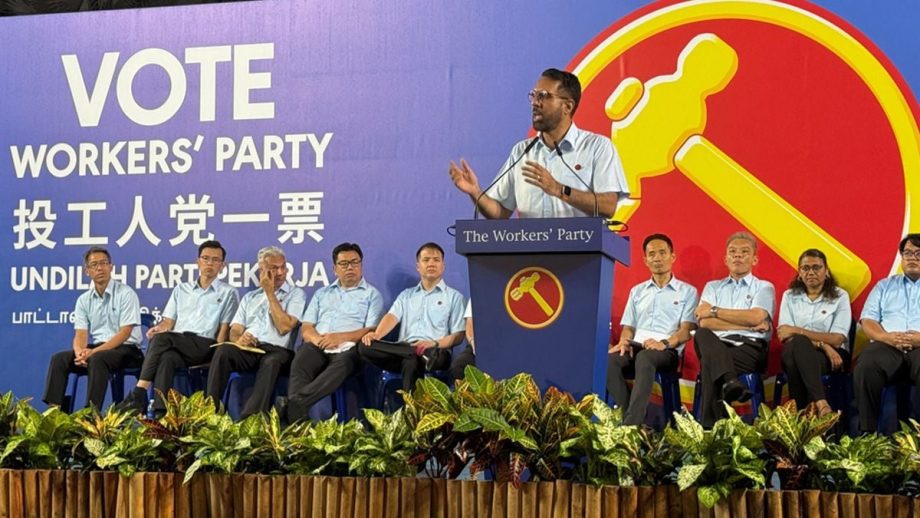
At the launch of his new book on 3 June 2026, former Workers’ Party (WP) Non-Constituency Member of Parliament (NCMP) Yee Jenn Jong made an observation that deserves to be taken seriously as political analysis rather than dismissed as partisan loyalty.
“Every leader from the opposition side, as long as you make some significant breakthrough and you are a significant threat, will face that sort of big challenge,” Yee said. “It happened with JBJ, it even happened to Low Thia Khiang. Whoever takes over, as long as the Workers’ Party is able to mount a very serious challenge, will be under a big microscope. I don’t know what will happen, but something will.”
Yee was speaking days before the WP’s special cadres conference on 28 June 2026, at which Secretary-General Pritam Singh faces a secret vote on his continued leadership following his criminal conviction for giving false evidence to Parliament’s Committee of Privileges (COP).
Singh’s appeal against his conviction was dismissed by the High Court on 4 December 2025. Justice Steven Chong upheld the trial judge’s findings and confirmed the sentence of two fines totalling S$14,000. Singh subsequently paid the fine. Speaking outside the court, he said he was disappointed with the verdict but respected and accepted the judgment fully and without reservation.
“Some of you would have followed this matter for some time. I certainly took too long to respond to Raeesah’s lie in Parliament. I take responsibility for that,” he told reporters. “My commitment in that regard remains unchanged. My focus now is to continue serving Singaporeans and to speak up for them, alongside my Workers’ Party colleagues.”
That statement matters for how this opinion piece should be read. Singh accepted the judgment. He acknowledged he was too slow. This is not a piece arguing that he was wrongly convicted or that the court reasoned incorrectly within the framework it was given. The criminal proceedings are concluded and the fine has been paid.
What I want to argue is something different and more structural.
In identifying the pattern described in this piece, I am not suggesting that the courts, the Attorney-General’s Chambers (AGC), or the Public Prosecutor failed to discharge their duties independently and according to law.
The People’s Action Party (PAP) itself maintains publicly that Singapore’s judiciary and prosecution operate free from political direction, and I accept that position for the purposes of this argument. The argument here concerns political decisions made by the PAP and its parliamentary representatives — decisions about which matters to investigate, which findings to act upon, and which referrals to initiate — not the conduct of the legal institutions that then processed those referrals independently.
That distinction is important and worth stating plainly. The PAP, as Singapore’s dominant political party, does not need to direct courts or prosecutors to shape political outcomes. It needs only to use its parliamentary majority to create the conditions — the audit panels, the COP compositions, the referral decisions — in which legal processes are initiated in one direction and not another. The courts and the AGC then do their jobs according to law. The political work has already been done upstream.
With that framing established, the question before WP cadres on 28 June is not whether Singh made errors. He did, and he has said so himself. The question is whether replacing him in response to PAP political pressure serves the party’s long-term interests — or whether it confirms that the strategy works.
What happened the moment Aljunied fell
After winning Aljunied GRC in 2011, the WP took over what became Aljunied-Hougang Town Council (AHTC), combining the newly won Aljunied GRC with Hougang SMC which the party already held. The town council was briefly renamed Aljunied-Hougang-Punggol East Town Council (AHPETC) following the WP’s 2013 Punggol East by-election win, before reverting to AHTC after Punggol East was lost at the 2015 general election. For ease of reference, this piece uses AHTC throughout.
The PAP’s political response to the WP’s 2011 Aljunied breakthrough did not begin years later with a lawsuit. It began within weeks of the election result, through a mechanism that had been quietly prepared in advance.
Action Information Management Pte Ltd (AIM) was a company with two part-time staff whose three directors were all former PAP Members of Parliament. In June 2010 — less than a year before the 2011 general election — the PAP’s town councils sold the Town Council Management System (TCMS) software to AIM through a sole-bid tender for S$140,000.
The software had originally been developed by National Computer Systems, paid for with residents’ conservancy fees. AIM then leased it back to PAP town councils at S$785 a month. The contract contained a termination clause allowing AIM to cancel its agreement with any town council experiencing a “material change in composition.”
The timing of the sale — to a PAP-owned company, through a sole bid, less than a year before an election — was not incidental. The termination clause was not incidental either.
In August 2011, weeks after the WP won Aljunied GRC, AIM terminated its contract with the newly WP-run Aljunied Town Council and refused to allow the WP to continue using the software.
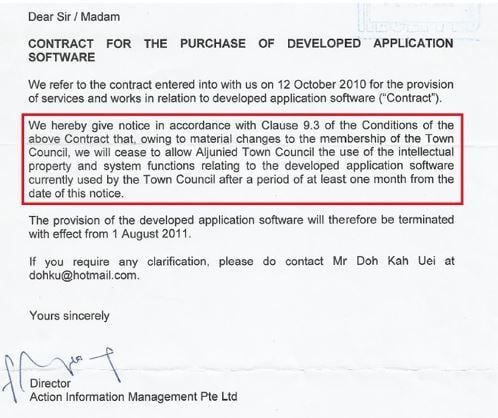
The WP was left to scramble, forced to upscale its Hougang management system to handle a constituency many times its original size, without the administrative infrastructure that every PAP town council continued to enjoy.
WP Chairman Sylvia Lim was publicly furious. “What justification was there for the Town Councils to relinquish ownership and leave the continuity of the Town Council operations at the mercy of a third party?” she said. “Residents all over Singapore have a right to know.”
PAP MP Teo Ho Pin defended the arrangement publicly, describing the termination clause as reasonable on the grounds that the contractor had priced its services on the basis of existing town council boundaries. What he did not explain was why a PAP-owned company capitalised at S$2, with three former PAP MPs as directors, had been the sole bidder for software paid for by residents’ conservancy fees — and why that arrangement had been structured with a termination clause that activated precisely when a PAP town council fell to the opposition.
Despite operating under these stripped conditions from day one, AHTC faced a sustained sequence of official scrutiny that ran for the better part of a decade. AHTC’s external auditors issued disclaimers of opinion on its financial statements for each year from FY2012 to FY2015, indicating insufficient information to form an audit opinion.
The Auditor-General’s Office then released a special report flagging significant governance lapses. The Ministry of National Development and the Housing Board applied to the courts to appoint independent accountants to examine AHTC’s books. The Court of Appeal ordered the appointment, and after both sides could not agree on a firm, directed AHTC to appoint one of the Big Four.
Read Full Article At Source