What separates a useful healthcare chatbot from a generic one?
For the winning team at the recent NUS-Synapxe-IMDA AI Innovation challenge, the answer lies in the foundational models underneath.
Team Assure, which compromises of six students from National University of Singapore (NUS)’ Business Analytics course, built a voice-enabled artificial intelligence (AI) companion within four months that conducts daily check-ins with elderly cardiac patients.
The check-ins were done in ways that reflect local language patterns, cultural nuances, and the sensitivity that care settings demand.
To do so, the team tapped into Singapore’s homegrown models, SEA-LION and MERaLiON, to “move beyond a generic chatbot and design something natural and familiar for elderly users, without compromising on the human-in-the-loop safeguards that sensitive care scenarios demand,” says a spokesperson from Team ASSURE to GovInsider.
While SEA-LION (Southeast Asian Languages in One Network) focuses on text and data, MERaLiON (Multimodal Empathetic Reasoning and Learning in One Network) goes beyond standard text-based AI by integrating multiple modes like speech-to-text, emotional and paralinguistic intelligence and more.
For the team, using local models was not an afterthought, but what made the solution viable for the people it was built to serve.
“Having LLMs that genuinely understand local language patterns and cultural nuance is what makes that possible,” he says.
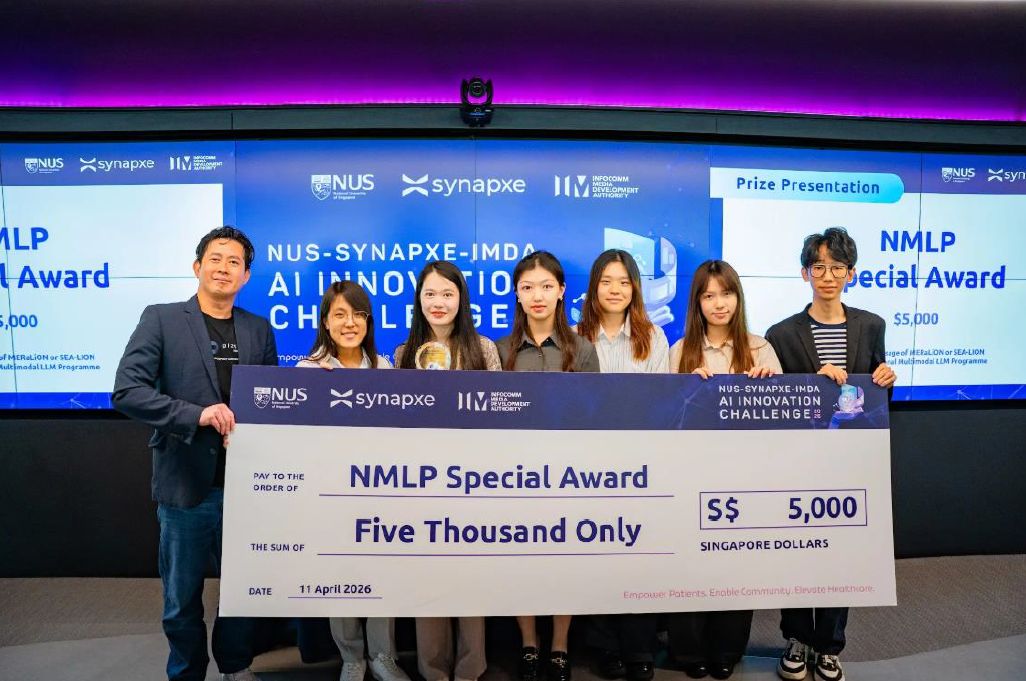
The winning team clinched the S$10,000 top prize, which was announced at the conclusion of the challenge on April 22.
In its 12th edition, the challenge was organised by NUS, Singapore’s Infocomm Media Development Authority (IMDA) and the national healthtech agency Synapxe.
Read Full Article At Source