SINGAPORE – On freelance photographer and videographer Eugene Tan’s LinkedIn profile picture sits a familiar ring styled after the professional networking platform’s “Open To Work” badge.
Except, instead of the usual green hashtag banner signalling availability to recruiters, the 23-year-old has a bright pink #OpenToDates badge edited on Photoshop.
The parody does not stop there.
In a Valentine’s Day LinkedIn post in the style of the millions of hyper-reflective career essays that flood the platform, Mr Tan writes that beyond a job, “youths like me are looking for a life partner too”, adding that relationships teach valuable skills such as leadership, organisation, visualisation and empathy – an acrostic whose first letters spell the word “love”.
It is, by his own admission, “50 per cent unserious, 50 per cent serious”.
“If something happens, then it happens,” he tells The Straits Times. “But if nothing happens, I’m okay with it.”

Mr Eugene Tan resorted to looking for love on LinkedIn after growing tired of dating apps, where interactions felt repetitive and overly curated.
PHOTO: EUGENE TAN/LINKEDIN
No dates emerged from the experiment. No romantic confessions slid into his inbox. Instead, secondary school classmates, polytechnic friends and old acquaintances resurfaced to tell him the post was funny.
One unexpected message from Singapore-based matchmaking agency Lunch Actually appeared in his LinkedIn inbox shortly after – proof, perhaps, that the algorithm nailed the assignment faster than any woman.
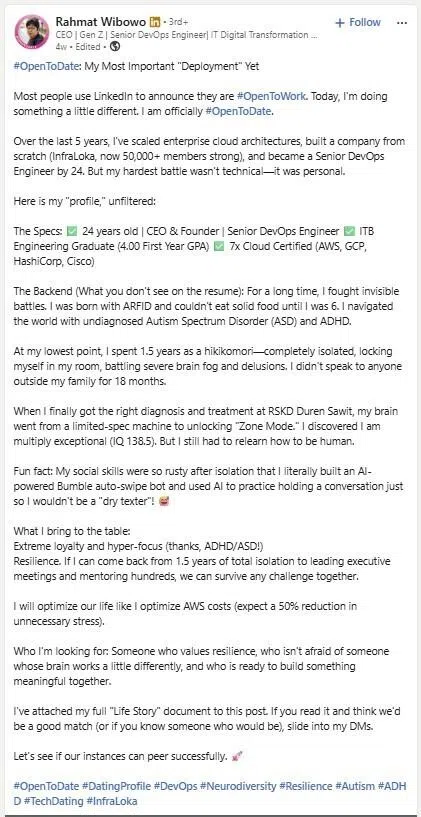
Across the platform, especially in India and the United States, users have begun posting dating resumes, compatibility decks, self-introductions and profile banners tagged with labels like #OpenToDate and #OpenToDM.
Screenshots of men posting elaborate dating “applications” and resume-style romantic pitches on LinkedIn have also spread across TikTok, Instagram and X. In the comments, reactions range from mockery and disbelief to admiration over the confidence and creativity behind these posts.
A TikTok search for “dating on LinkedIn” throws up dozens of videos documenting relationships that began on the platform – particularly in the US.
Among them is US-based lifestyle influencer Paige Goldstein with 21,300 followers. She posted in 2025 that she met her boyfriend on the platform after she began sharing more personal content on it. That expanded her network, a mutual connection tagged her in one of his posts and the rest is history.
Such lovelorn humour, personality and casual self-presentation – once largely relegated to social media platforms like Instagram and TikTok – have found their way onto LinkedIn.
Assistant Professor Lew Zijian of Nanyang Technological University’s Wee Kim Wee School of Communication and Information, who researches online self-presentation and digital behaviour, does not find this surprising.
Using LinkedIn to look for romance is simply an extension of how people already use Instagram, TikTok and Facebook to meet potential partners, except LinkedIn allows users to see far more of a person before speaking to him or her.
“With dating apps, there’s an element of chance or some sort of unknown algorithm working for or against you,” says Prof Lew. On LinkedIn, by contrast, “people know exactly who they are approaching”.
The profile is already there – so are the schools, jobs, public posts and years of accumulated self-presentation. Users get an instant rough sketch of a person’s ambitions and worldview. Or, as Prof Lew puts it more bluntly, LinkedIn gives users “a better sense of whether you’d be dating a clown or not”.

Freelance photographer-videographer Eugene Tan pitched himself as a prospective romantic partner on LinkedIn.
ST PHOTO: SARAH LEE
That was the reason Mr Tan resorted to looking for love on LinkedIn. After several months without a single match on Hinge, Coffee Meets Bagel and OkCupid, he grew tired of dating apps, where interactions felt repetitive and overly curated.
“Dating apps have this stigma that it must always be romantic or lead to something,” he says.
LinkedIn, oddly enough, feels less stressful. There is something psychologically different about attraction forming on a platform not built for dating, he adds, saying he prefers the “friends-to-lovers route”, where relationships evolve more naturally.
On dating apps, users are primed to evaluate suitors through photos, prompts and short bios, while LinkedIn interactions feel “more incidental”, he says. Conversations tend to begin through shared schools, industries, mutuals or public posts first.
“You have credibility,” adds Mr Tan, who graduated from the Royal Melbourne Institute of Technology in 2025. “If someone knows your mutual contacts, they can always ask them, ‘What’s this guy like?’”
Prof Lew notes that these visible mutuals and professional networks allow users to make judgments using the same heuristics they already apply offline. If someone shares similar circles, schools or colleagues, they may immediately feel more trustworthy or socially compatible. There is also simply “more of a person” available to observe.
Even then, Mr Tan says he drew certain lines for himself. He never messaged women on LinkedIn because he felt it would be intrusive on such a platform.
Conversely, he notes that younger users no longer separate their professional and personal selves online as rigidly as previous generations did.
“We’re more unserious now,” he says. “The internet has allowed us to express our personality more.”