HTC’s new smart glasses launched in Singapore

HTC’s new smart glasses launched in Singapore


Note: This story was first published on 12th March 2026.

HTC isn’t a brand we cover often these days, but when we do it’s usually about their VR/XR division, which is still going strong. Evidence for this is the HTC Vive Eagle, its first pair of AI smart glasses. First announced in August last year, the company has announced its launch in Singapore, in partnership with Singtel.

HTC is angling the Vive Eagle to be an ever-present partner for daily life, utilising a combination of Google Gemini and OpenAI GPT (beta) to get the job done. Simple tasks that the Vive Eagle can accomplish include taking calls and listening to music, done through an open-ear speaker built into the frame. The Vive Eagle can do more complex tasks as well, including adding events to your calendar and taking search queries for things like finding restaurants and news headlines.

Of particular note is the camera – a 12MP ultrawide lens, to be precise – which can take pictures and translate text via voice commands. The translation feature currently supports over 70 languages; it’s at this juncture that we should mention the Vive Eagle itself supports voice interactions in English, Mandarin and Cantonese (in beta).
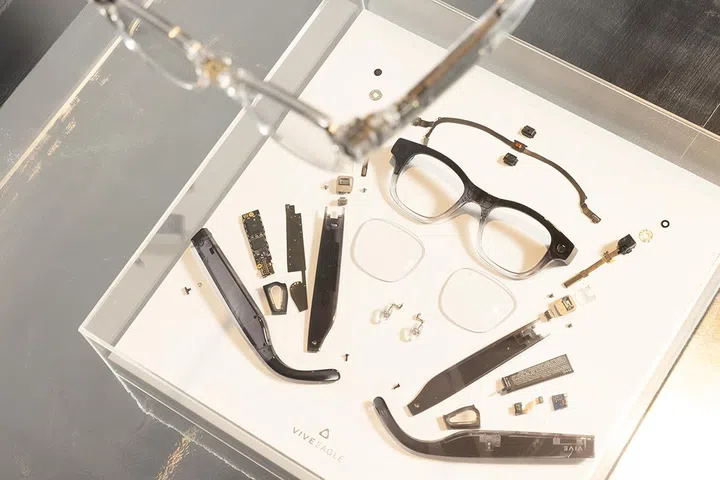
The Vive Eagle has an open-ear speaker for taking calls, and also has a 12MP ultrawide camera for taking photos and translating text.

The Vive Eagle has an open-ear speaker for taking calls, and also has a 12MP ultrawide camera for taking photos and translating text.

Via the Vive Connect App, the smart glasses are also capable of storing details from voice memos, which can then be retrieved at a later time. An upcoming software update to the app will also introduce an AI Notes feature, where conversations will be transcribed into notes, with instant summaries available. The Vive Eagle’s AI assistant also continues listening for a short period after it answers your initial query, which HTC says allows the conversation to continue without having to repeat the wake word. 

To allay any security concerns, HTC states that the AI is certified to meet ISO 27001 and 27701, which are two privacy and security standards established by the International Organisation for Standardisation. Local storage is also encrypted.

About the rest of the hardware, the Vive Eagle weighs just 49g, and is powered by a 235mAh battery that HTC says is capable of reaching 36 hours in standby and 4.5 hours of continuous music playback, with charging speeds of 50% in 10 minutes

As for the ‘glasses’ part of the equation, the Vive Eagle comes with either Zeiss UV400 sunlenses, which are designed to protect the eyes from UV rays, or Zeiss’s AdaptiveSun Lenses, where the tint of the lens changes depending on light intensity.

 Pricing and Availability

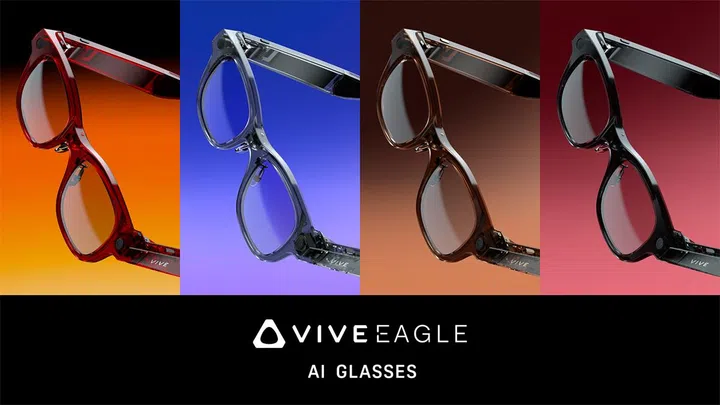
The Vive Eagle comes in four colours and two sizes.

The Vive Eagle comes in four colours and two sizes.

Image: HTC.

The HTC Vive Eagle is available through Singtel’s online shop now, and goes for S$730 for the UV400 lenses, and S$880 for the photochromic AdaptiveSun lenses. If you want to try them out for yourself, you can also head down to selected Singtel stores at these locations.

The smart glasses also come in two sizes (M/L), and four colourways: Berry, Coffee, Grey and Black. M is available for all four colours, but you can only get an L size for the latter two.

Our articles may contain affiliate links. If you buy through these links, we may earn a small commission.


Read Full Article At Source