SINGAPORE – A judicial decision may prompt a review of practice by the Cabinet, public consultation or changes by Parliament but this does not mean the judiciary has assumed a political function.
Chief Justice Sundaresh Menon on Nov 25 said such reviews simply reflect the way in which the other branches of government work through legal implications of a judgment as they exercise their own constitutional responsibilities.
In Singapore, the branches of government are the executive, which comprises the Cabinet, the legislature, which comprises Parliament, and the judiciary.
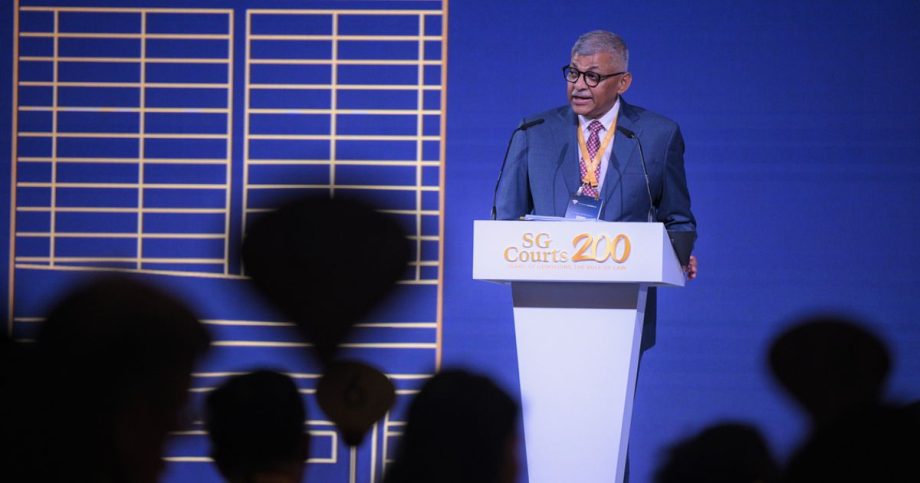
Menon was delivering the keynote address at the Global Rule of Law Conference held at Shangri-La Hotel.
The outgoing Chief Justice, who is due to retire in February 2027, did not mention this in his speech, but one recent example of this constitutional dialogue was the introduction of the Sentencing (Scams) Bill in Parliament on Nov 3, which followed a recent High Court ruling that favoured rehabilitative options for young scam offenders.
The High Court had in September allowed the appeals of four young scam offenders who were sentenced to reformative training, and instead ordered them to be placed on probation ranging from a year to 18 months. These four committed their offences while under the age of 21.
The proposed law means that young scam mules could soon face jail or reformative training as the default punishment rather than probation, to reinforce the Government’s deterrent stance against such offences.
In his speech, Menon cited the example of Singaporean businessman Tan Seet Eng, who was detained without trial in 2013 by order of the minister under the Criminal Law (Temporary Provisions) Act, on the basis that the detention was in the interest of public safety, peace and good order.
Tan was alleged to be the leader and financier of a global football match-fixing syndicate.
Menon said the Court of Appeal set aside the minister’s order, holding that the Act permitted detention only where the detainee’s acts were harmful in Singapore, and that the grounds provided did not establish if or how Tan’s activities bore on public safety, peace and good order here.
The consequences of the decision extended beyond Tan, said the Chief Justice.
Read Full Article At Source