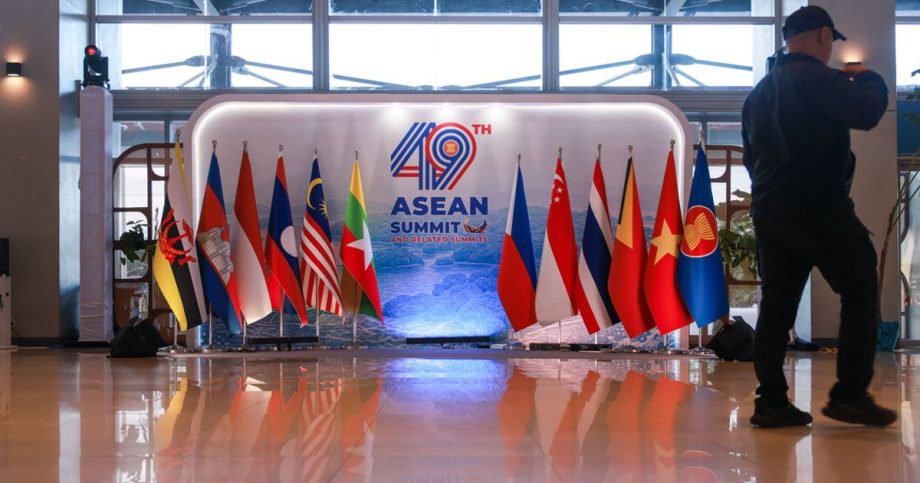
On November 17, Prime Minister Lawrence Wong announced the theme for Singapore’s ASEAN chairmanship in 2027: “Deeper Integration, Wider Partnerships”. As Singapore prepares to take the chair, knowing what ASEAN can and cannot do tells us where to invest in it, what to expect from it, and where our own responsibility begins.
At ASEAN’s founding in 1967, our first foreign minister, S. Rajaratnam, is reputed to have warned that if we did not hang together, we would hang separately. By choosing to hang together, the founding members helped turn neighbours who had threatened one another into neighbours who could manage their differences. That is one reason why, 59 years later, the main pressure on Singapore comes from the great powers rather than from our neighbours.
That pressure manifests as five kinds of demand. America and China are now rivals, and each fears that what we give its rival will be used against it. So each asks us to decide in its favour: whether its forces may use our ports and airfields, whose rules we apply, whose suppliers we exclude, which country’s laws our firms obey, and what we say on disputes such as the South China Sea. Answered one at a time, such demands can add up to taking a side nobody chose.
What ASEAN cannot do
ASEAN is an association of governments, not a government above them. Its Charter makes consultation and consensus the basic rule, and no regional body can make decisions for a member on matters it regards as vital. When Washington announced its tariffs in April 2025, the European Commission negotiated for the whole Union. ASEAN’s economic ministers agreed within eight days not to retaliate, but each government then negotiated its own terms.
What ASEAN can achieve therefore differs across the five demands. Military access and our diplomatic positions remain national decisions. Regional cooperation can go further on common rules and supplier choices, though it cannot remove conflict between foreign laws.
Across all five, ASEAN’s help also has two limits. First, it cannot guarantee that members give the same answer. Singapore and the Philippines have joined Washington’s Pax Silica initiative on AI supply chains, while several others have joined the founding agreement of the China-initiated World AI Cooperation Organisation. So Singapore cannot count on the others to answer a demand as we do.
Second, ASEAN cannot make others bear the cost of a decision one member takes for itself. When China held up imports of Philippine bananas during the 2012 stand-off at Scarborough Shoal, no other member was obliged to compensate the Philippines.
ASEAN was built loose on purpose and that is one reason it has lasted. Consensus means neither Washington nor Beijing can shut the other out of ASEAN’s forums as some ASEAN members would always object to either great power being excluded. And because no member can be outvoted on what it regards as vital, members have less reason to leave, and in almost 60 years none has. But looseness is also why ASEAN is less effective than many would like.

Prime Minister Lawrence Wong (right) receives the ASEAN chairmanship gavel from Philippine President Ferdinand R. Marcos Jr. during the closing ceremony of the 49th ASEAN Summit in Manila on Nov 17.
ST PHOTO: GAVIN FOO
What ASEAN can do
Nonetheless, ASEAN improves the circumstances in which we make our decisions in three vital ways.
The first is to help preserve peace among neighbours. A state at odds with its neighbours may invite outside support, and external powers can then turn a local quarrel into a proxy contest, as in Indochina from the 1950s to the 1980s and in Syria in the 2010s. ASEAN reduces this risk by helping make law and negotiation the usual way members settle disputes. When Singapore and Malaysia accepted the International Court of Justice’s judgment on Pedra Branca in 2008, neither needed an outside patron.
Read Full Article At Source