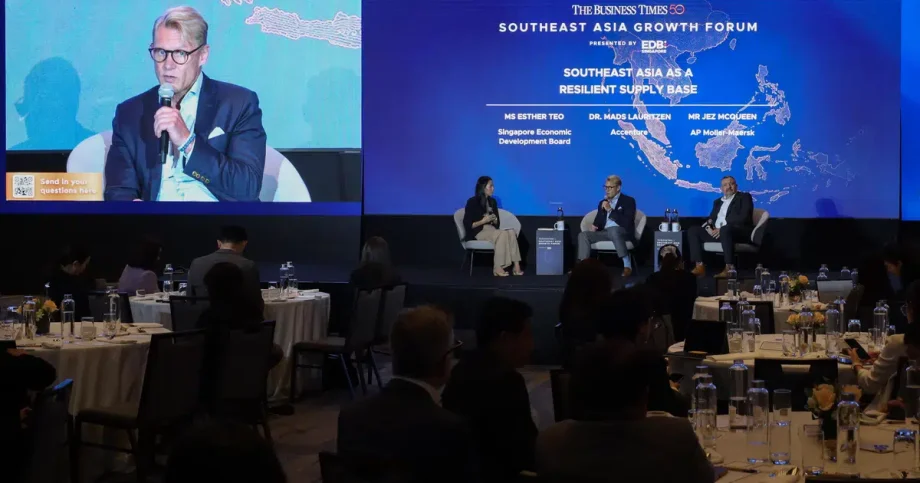
Relocation, AI and customs hurdles were discussed at a forum on South-east Asia supply chains
[SINGAPORE] The “China plus one” playbook is giving way to “South-east Asia plus one”, as manufacturers shift production within the region rather than out of it amid supply chain disruption and tariffs, said panellists at a forum on Wednesday (Nov 18).
The South-east Asia Growth Forum, jointly organised by The Business Times and the Singapore Economic Development Board (EDB), closed with a panel discussion on building competitive and resilient supply chains in South-east Asia. The discussion was moderated by Esther Teo, director of the Johor-Singapore Special Economic Zone Programme Office at EDB.
With geopolitical tensions pushing companies to diversify, manufacturers are increasingly moving plants out of China, said Mads Lauritzen, chief strategy officer for South-east Asia and supply chain lead for Asia-Pacific at Accenture.
He noted that China’s share of US imported manufactured goods has fallen from more than 20 per cent to less than 10 per cent over four years, and that three in four US manufacturers are pulling their supply bases out of China into the rest of Asia, with South-east Asia the biggest recipient.
The narrative has shifted from “China plus one” to “South-east Asia plus one”, he said, with the extra site often found within the region. He pointed to electronics clusters in Penang, Hanoi and Ayutthaya, and automotive hubs in Rayong and Jakarta.
Apparel production is moving south from Vietnam to Indonesia, said Jez McQueen, area head of sales for South-east Asia at AP Moller-Maersk, while some solar manufacturers hit by US tariffs have relocated from China to Malaysia and Indonesia, and now the Philippines.

Many rushed shipments to the US ahead of a tariff cut-off, he added, to avoid holding inventory when higher per-watt-hour duties bite.
But many companies have diversified only on paper and still rely on a single source for inputs, Lauritzen added, noting that two-thirds of electronics manufacturers in the region were hit by disruption from single sourcing in the past 18 months.


Read Full Article At Source